[box type=”shadow” ]
Case Study:
PARAMA ISLAND – PARK CIRCUS ELEVATED CORRIDOR
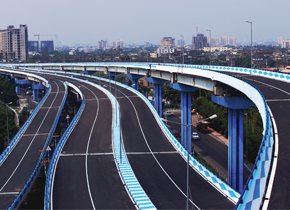
Better traffic management with Kolkata’s longest flyover
The main flyover and one connector of the Parama Island – Park Circus Elevated Corridor became operational in 2016 while the second connector is under construction
The elevated corridor project was announced by the Kolkata Metropolitan Development Authority (KMDA) to decongest the already available alternative that was provided by the Eastern Metropolitan Bypass (EM Bypass) for the other inbound roads to the heart of the city. The aim was to address the needs of those commuters who wished to avail the faster alternative from the Airport to the Vidyasagar Setu via the AJC Bose Road flyover and further towards the NH2 and NH6 via Kona Expressway. Approximately over one lakh vehicles will predictably use this flyover every day.
The road connecting Parama Island and Park Circus is a four lane old road that does not have any further scope for widening. The ever increasing traffic through this route causes a major congestion at the Park Circus 7 point junction, with vehicles pouring in from CIT Road, Shakespeare Sarani, APC Road, Ballygunje and Exide Crossing. Moreover, this road passes through six major junctions viz Park Circus Junction, Nasiruddin Road / Congress Exhibition Road Crossing, Darga Road Crossing, Topsia Road Crossing, Govinda Khatik Road Crossing, Parama Island and Dhapa Crossing, where the traffic moves at a snail’s pace. The seasonal fair organized at Milan Mela grounds attracts crowds and traffic which can be described as colossal. The elevated corridor will thus allow smooth movement of traffic from Parama Island to Park Circus. This will also ease the VIP movement along this route without disrupting regular traffic on the ground level.
Super-sized flyover
Parama Island – Park Circus elevated corridor project consists of:
• A 4.2km long four lane main elevated corridor starting from EM Bypass and taking a turn at the Parama Island towards Park circus and ending at Park Circus 7 point junction.
• Two ramps of 400m and 900m from southern side of Parama Island that joins the main corridor for up and down movement of traffic going toward Garia
• Two ramps of 1000m and 885m connecting AJC Bose road flyover that will allow seamless movement of traffic to and from Kolkata Race Course without the need to get down at 7-point junction
• Two pedestrian underpasses of 6.0m wide each; one for easy movement between Milan Mela and Science city and the other for easy movement between Energy Education Park and Science city
Challenges encountered
Working in a congested corridor: The alignment of the project passes through a very congested corridor of the Park Circus connector road. There was no further scope of widening this road and the work had to be carried out in moving traffic. On the other hand, there was no possibility of diverting the existing traffic to some other route.
Typically, a project such as this requires a clear working front of approx. 1 to 1.5km stretch, whereas the traffic police department was not allowing to cordon off the minimum necessary area for such lengths. The barricading was allowed only in patches of 200 to 300 meters. This reduced the working front and slowed down the progress of the project considerably.
Hindustan Construction Company, which carried out the project, had deployed three hydraulic piling rigs initially, which could do around 100 piles in a month. Due to non-availability of a longer stretch, the company was forced to do only 24 piles and the piling rigs remained idle the rest of the time. The situation eased much later. Secondly, the width of the pier cap is 16.5 meters. For safe working conditions, the team required more than 17 meters to put up barricades along the entire stretch of the road. This could have resulted in only one lane on each side for traffic movement, further adding to the problems of an already congested corridor. Hence, only 9m barricading was allowed along the entire stretch. To deal with such a situation, a special cross beam support system was done within the 9m stretch that extended outwards for the entire 16.5m width of the pier cap. This was further enhanced by the use of safety nets to ensure safety of the traffic plying underneath.
In addition to this, the team introduced pre-stressing in all concrete pier caps to avoid highly congested reinforcement and to reduce the cycle time of de-staging the pier cap considerably.
 Traffic movement: For the ease of the traffic movement while working on the project, the width of the existing road was increased in a few patches by cutting down the footpath. The movement of heavy machineries and construction materials were done during non-peak hours. Girder shifting and placements were done only in night shifts between 11:00pm and 6:00am. Extra precautions were taken by blocking the stretch where the girder placement was undertaken and diverting the traffic onto one side of the road.
Due to the restriction of heavy vehicle movement during peak traffic hours, the entire time-cycle of the project was managed in such a way that the major concreting and equipment shifting were done only in the night.
Utility shifting: Along the alignment of the project, there were several utilities such as sewerage lines, storm water drainage, water supply lines, gas lines, telephone lines, Calcutta Tramways lines, optical fibre lines and electric supply lines.
No clear route maps were available for these existing underground utilities with most of the agencies. Hence, for each and every pier location, trial trenches of 1.2m width and 2.5m depth were dug-up to ascertain presence of underground utilities. By studying the pattern of around 4-5 pier locations, suggestions were given to the client for shifting of these utilities.
Initially, the utility shifting work was not in the scope of HCC. However, after Kolkata High Court intervention, for faster progress, the same was introduced into HCC’s scope. While shifting these utilities, coordination with various utility agencies including Kolkata Municipal Corporation (KMC), Calcutta Electric Supply Corporation (CESC), Greater Calcutta Gas Supply Corporation Ltd (GCGSCL), BSNL, Calcutta Tram Company (CTC) was very critical. Again, the intervention from Kolkata High Court worked seamlessly in getting approvals from these authorities. As per the High Court order, a high level coordination committee was formed chaired by the minister in-charge of urban development and municipal affairs to take prompt decisions and to oversee smooth progress of the project.
Proximity of residential buildings: The stretch between Darga Road to Park Circus 7 point junction, Circus Avenue, Congress Exhibition road and Nasiruddin road houses a few of the oldest residential and commercial units that date back to the Victorian era. The project being in close proximity to these structures posed a grave threat to the stability of these units. Moreover the vibrations that emanated from the various construction activities might have had a detrimental effect on the same. While working in these areas extreme precautions were taken to take care of these structures. Equipment such as vibrohammer were avoided for piling and other activities. A methodology was developed to work in these areas to ensure minimal vibrations.
Girder erection at Parama island junction: The steel trapezoidal box girders erection was a real challenge because of the height of the piers. The pier height at this location is 18m, equivalent to a four storey building. Secondly, the girders had a curvature of 105m radius. The launching of these girders was done in four parts and required huge temporary trestle support systems at splicing joint locations. The traffic conditions below the girders did not allow any activity during the day time and the authorities had given a very tight time window of only 15 days to complete the activities in each span. Meticulous planning and execution along with timely coordination with the traffic police helped the team to complete this activity in time.
Obstacle of Victorian era utility: There are huge sewer lines on the road that leads to Bridge No. 4 from the Park Circus crossing. This sewer line was built during the Victorian era and is made up of brick and mortar. Hence, shifting of this line was an impossible task. The Calcutta Municipal Corporation meant to find a way out so that the sewer lines could be shifted and space culled for the pillars. However, they could not find an effective solution. After studying the sewer line, the HCC team came to a conclusion that instead of shifting the sewer line, the structure of the pillar needed alteration. So the design team of HCC came out with an overhead portal pier design instead of a single pillar in the middle. For faster implementation of these overhead portal pillars, structural steel was used for the design.
Travelers’ joy
The Parama-Park Circus flyover will be the city’s longest elevated corridor, reducing the commuting time between east and central Calcutta by more than half. “It should take hardly 10 minutes to reach Parama Island from Park Circus via the flyover. It takes about 40 minutes now,” stated a KMDA engineer.
Better living conditions
As a result of reduced travel time and smoother traffic movement, the idea of an economic and green corridor can be fortified based on the facts that lead to lesser fuel consumption and lesser traffic congestion that further leads to lesser pollution viz emission and sound. The accident rates will also reduce significantly as the project provides two pedestrian underpasses at critical junctions to take care of the pedestrian movements even in the festive seasons at Milan Mela Ground and Science City.
Project yet to be completed The main flyover of the elevated corridor was opened in 2015 and the East bound arm of the flyover was opened to traffic in August 2016. The work on the West bound link is in full swing. Once completed, these two connectors along with the main flyover will provide an uninterrupted route to and from EM Bypass and Central Business District of Kolkata.
[/box]
(Information as provided by HCC)