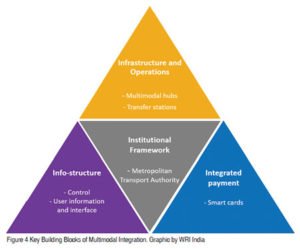
A high-quality integrated multimodal system comprises the following building blocks:
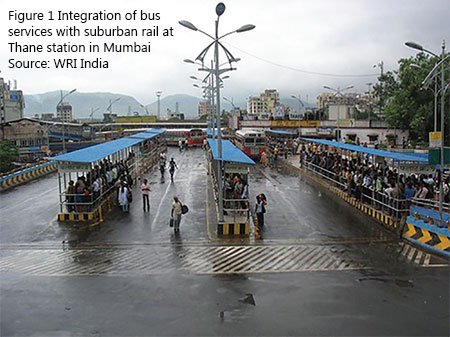
- Infrastructure and operational integration – different transport modes connected physically as well as operationally, with transit hubs and complementary schedules that facilitate ease of transfer between modes
- Information integration – information systems help service providers achieve operational integration in addition to providing real-time information to passengers on various modes regarding connectivity options, routes, schedules, and fares
- Fare integration – integrated payment solutions like smart cards allow seamless access and payment across different modes.
Achieving integration at these levels requires a strong institutional and governance framework. Full-scale multimodal integration includes the integration of mass transit modes within a city with one another, as well as the integration of mass transit modes with other feeder modes, which helps provide first- and last- mile connectivity. First- and last-mile connectivity refers to the ease of access between mass transit stations, and the users’ starting points and final destinations, such as homes and offices. While mass transit systems such as the metro rail cover the middle miles of passenger commutes, ensuring the first and last mile linkages is critical to enabling seamless and end-to-end transportation systems designed around public transportation.
[box type=”shadow” ]At last count, about 350 kilometers of metro rail corridors are operational in nine cities- Delhi, Bangalore, Chennai, Mumbai, Kolkata, Kochi, Jaipur, Lucknow, and Gurgaon.[/box]
 The Station Access and Mobility Program
In June 2017, the final stretch of Phase 1 of Bengaluru’s Namma Metro was opened to the public. With an operational network of 42 kilometers and 40 stations, Namma Metro is the second largest metro system in India. Work on the 72.1-kilometer Phase 2 has already started, and hope that the metro will ease the city’s infamous traffic problems is high among all. What now remains to be addressed is the mobility transition that needs to occur among urban commuters – away from a growing trend of private vehicle use towards modes of public and shared transportation.
The Toyota Mobility Foundation (TMF), in collaboration with the WRI launched the Station Access and Mobility Program (STAMP), which focuses on high-quality first- and lastmile connectivity to the Namma Metro in Bengaluru. The program acts as a city laboratory, bringing together citizens, entrepreneurs and government agencies to co-create solutions for seamless connectivity. As one of India’s first open innovation programs in the urban mobility sector, STAMP aims to nurture innovation for multimodal integration and connectivity that makes it safer, more affordable and more convenient to access Bengaluru’s metro stations.
STAMP mobilizes the following approach for turning ideas into action:
- Identify: issues and opportunities through surveys of Namma Metro users and non-users, and an analysis of the collected data
- Enable: stakeholders through workshops and interactive sessions with residents, entrepreneurs, government agencies and elected representatives
- Catalyze: innovation and change through the STAMP Challenge to identify, incubate & promote technology-based solutions for lastmile connectivity
- Implement: solutions through pilot projects around station areas, and promote learnings of public-private collaboration for multimodal integration
 The STAMP Challenge invited applications from entrepreneurs, citizen groups, researchers and students, for proposals to improve lastmile connectivity to Namma Metro. Over 80 applications were submitted, with proposals ranging from feeder systems to shared mobility solutions, multimodal information systems, parking management solutions, and product innovations. The focus was on economically sustainable and scalable proposals oriented towards the end-user, in this case the metro commuter. A jury of startup investors, entrepreneurs, lawyers and mobility experts selected the top 13 proposals to form the STAMP cohort.
The STAMP Accelerator for the cohort was kick-started with an intensive five-day boot camp tailored for mobility entrepreneurs and change makers. The objective of the boot camp was to equip the STAMP cohort with the necessary skills and connections to navigate governance frameworks and integrate their services with the Namma Metro system. Teams had the opportunity to interact with officials from the transit agencies- the Bangalore Metro Rail Corporation Limited (BMRCL) and the Bangalore Metropolitan Transport Corporation (BMTC)- as well as with members of Karnataka’s IT-BT department, which is responsible for the state’s startup policies and initiatives.
 The boot camp culminated with a Pitch Day, at which five final recipients were awarded research grants to support pilot projects of their proposals in coordination with the metro. The five winning proposals include services, delivered by mobile applications, for Point A- Point B (one-way) scooter rentals, carpooling, on-demand auto rickshaw hailing, on-demand parking, and an app-based assessment index that measures the accessibility of station areas based on specific parameters.
The STAMP pilot projects, in operation from September 2017 to December 2017, are an opportunity to promote higher levels of service and connectivity for metro commuters, to expand the reach of the metro rail network to a larger number of people, to integrate multimodal services for more seamless passenger journeys, and to understand the potential of using data for improving urban mobility as a whole.