
Journey Management
- Define duty hours/weekly time off.
- Plan routes and establish delivery times.
- Rest breaks ? minimum of 20 minutes every four hours.
- Vehicle tracking systems (including tachographs and telematics).
- Display emergency contact numbers.
 A consortium of Shell, GRSP and AIMTC aimed to expand the programme including the development of a set of five training modules to 100 transporters in South India. Although no further evaluation data is available, and much of the detail about this project has been removed from the Shell India internet site, this partnership approach and focus on better management of the informal transport contracting sector is worthy of further development and evaluation.
Another similar project in India is being implemented by the US National Institute for Occupational Safety and Health (NIOSH) and the Indian Institute of Road Traffic Education (IRTE). It aims to develop and implement a two-level fleet safety programme at demonstration sites in India, focusing on heavy-goods vehicles from the informal sector. The first component is driver training, and the second is developing capacity for road safety management within Indian transport companies.
Funding is provided by the Conrad Hilton Foundation with administrative assistance from the US Centres for Disease Control (CDC) and Prevention Foundation. Over 1,100 informal sector drivers have been trained to date and they have gained substantial knowledge before and after training. IRTE is now developing a series of management workshops geared towards transport operators.
Correspondence from the World Road Safety Partnership (WRSP) suggested that in the fast developing countries such as India, road safety engineering, enforcement and education are improving. Post-collision emergency care management is also improving, but many fatalities and disabilities still occur as a result of improper handling of the casualty at the scene or while transporting the victim to the hospital. WRSP opines that better management of the ?golden hour? processes involved in saving a person from the collision scene, would help to save lives and reduce long term disablements. This would include an improved ?first responder? system, the highway patrol (Police) that is better trained for attending collision emergencies, improved extrication and rescue operations and better at-scene first aid. WRSP produces a range of research, resources and documents to support this process, although nothing specific on occupational road safety.
All in all, the data and initiatives to date suggest that work-related road safety offers an opportunity to protect workers in India, and to help reduce the burden of road fatalities ? for which the Haddon Matrix provides a useful framework.
Using the Haddon Matrix to improve work-related road safety in India
 The Haddon Matrix provides an all-encompassing pre-crash, at-scene and post-crash systems-based framework that incorporates all the good practices identified in the NIOSH research and is supported by an increasing body of published evaluation data, and many as yet unpublished outcomes. Along with classifying improvement interventions to be piloted, implemented and embedded, it can be used as a self-review or risk assessment tool by asking: ?Do we have the following in place?? for each of the statements in the Matrix. ?No? responses indicate the gaps in the fleet safety system. It can also be used as a tool for undertaking detailed post event investigations.
The starting point for any organisation is the top left hand corner in the Management section. This gives a good idea of the types of management initiatives to be put in place to understand and manage the risks. Over time, the Haddon Matrix can be used in more detail to review performance and set targets across all the areas in Figure 4.
Detailed case studies showing how the Haddon Matrix has successfully been applied in many organisations can be seen on www.fleetsafetybenchmarking.net. Examples and freely available tools to allow organisations to undertake a gap analysis and benchmark their performance too can be found on the site.
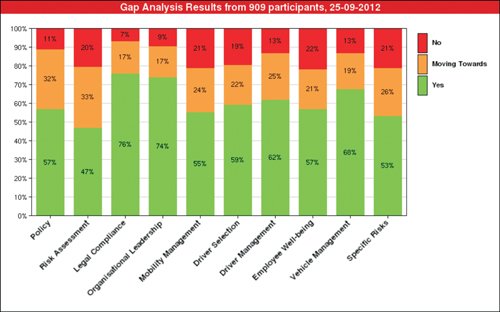
This will allow a quick and easy, five minute starting point to benchmark the performance against 900+ other organisations around the globe (Figure 5).
Many organisations have successfully protected their workers and local community members through this. They have also significantly cut their collisions and costs along with improving their brand through this type of programme.
Work-related road safety can be a conduit for community road safety in India. Driving for work is a significant risk in India. This means that the workplace is an opportunity to target employees, family members and local communities who are a captive audience because employers affect them economically and have a degree of control over them. The Haddon Matrix provides an excellent framework for this purpose. Organisations in particular and society in general can gain many benefits from developing such programmes.
Research and good practice is continuing to develop at a fast pace in the risk and safety area and the following websites are recommended to the readers to keep themselves abreast of the latest research and trends: www.virtualriskmanager.net/niosh, www.virtualriskmanager.net/news and www.virtualriskmanager.net/research
Dr Will Murray Research Director Interactive Driving Systems
(Will has been involved in research, policy and practice in occupational road safety for over 20 years. He is also a Visiting Fellow at Loughborough University in the UK and CARRS-Q in Australia, as well as a Trustee of the Road Safety Charity, Brake).
Research Director Interactive Driving Systems
(Will has been involved in research, policy and practice in occupational road safety for over 20 years. He is also a Visiting Fellow at Loughborough University in the UK and CARRS-Q in Australia, as well as a Trustee of the Road Safety Charity, Brake).