
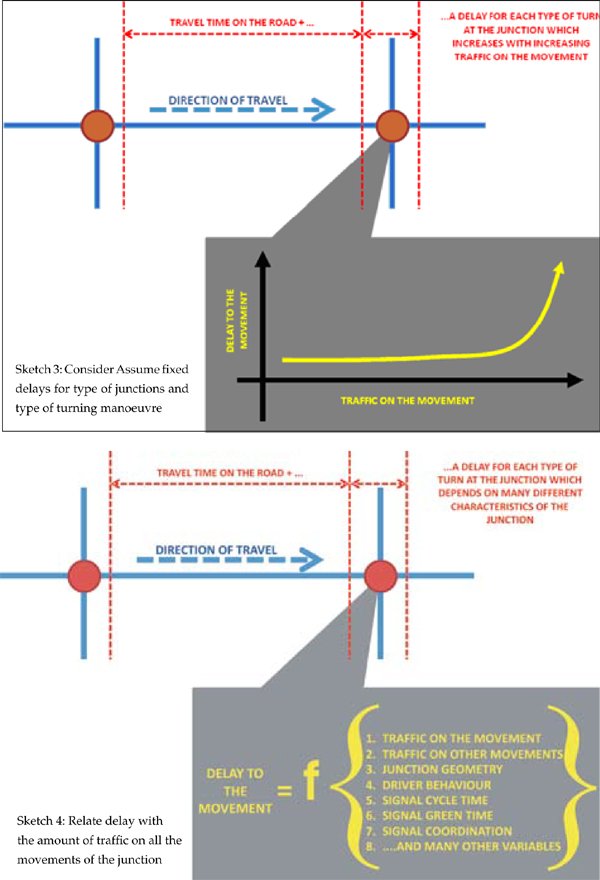
 Assume fixed delays for type of junctions and type of turning manoeuvre: This is the next best strategy. The modeller counts how many junctions s/he has to deal with and divides them into a number of bins – big nasty ones, small innocent ones, etc. S/he may also divide junctions based on what type of control mechanism is used – traffic light, roundabout, stop & go, etc. And for each of the junction type, s/he divides the type of turning movements the vehicles do at these junctions such as straight-through, right-turn, left-turn or U turn. Then, based on the surveys or professional experience, a fixed delay is assumed for each turning movement of each junction type (See Sketch 2). Sometimes, details of green times of traffic lights can also be included to make this more precise.
This is definitely an improvement over the previous strategy of ignorance. But it is just, an incremental improvement, and nothing more. It is not difficult to see that delays depend on many more factors than a simple generalisation of junction types and turning movements. And that is why we need the next point for consideration.
Relate delays with the amount of traffic on the movement: This is the next best strategy for assuming fixed delays. It involves careful observations of delays experienced by traffic at junctions under varying traffic conditions. This is followed by establishing a mathematical relationship of how delay to a traffic movement increases with the increasing amount of traffic on that movement. Obviously, the more the traffic, the more is the delay (See Sketch 3). And because of this, the predicted delays in traffic models become more accurate. It is obvious here that the effort required here will be higher because relationships of amounts of traffic and delay will be different for different types of junctions and different types of turning movements.
But a problem remains. You will notice that the delay you experience at a junction not only depends on the amount of traffic of the turning movement you are part of but also the amount of traffic on turning movements you have to cut through. For example, if you are on a minor road (with not much traffic) and try to negotiate a right turn on a busy major road, you still experience delay. And this is precisely why the next level of detail needs to be considered.
Relate delay with the amount of traffic on all the movements of the junction: This is the holy grail of junction delay modelling where the estimation of delay to a movement is modelled based on all details of the junction. It needs detailed information of the junction geometry (lanes, lane width, turning pockets, etc.), control details (signal cycle time, green splits, etc.) and traffic details (See Sketch 4). The resulting modelling process is not only data hungry but also computationally demanding. The research and software to do this are mostly bought from overseas and require special expertise. For this reason, it is only recommended for small areas with few junctions. But if a careful effort is made, gains are manifold and go beyond the increased accuracy of the models. It not only forces the traffic model to become a repository of all junction details (a kind of asset management system) but also provides useful insights into the working of various types of junctions.
 Micro-simulation: The approach of micro-simulation is the most detailed approach of traffic modelling. Instead of trying to understand the traffic flow and its response to various control strategies (including junctions), it involves modelling each individual vehicle and its response to every other vehicle and traffic furniture in the vicinity. Computationally, it’s an approach miles apart from any of the ones described above.
It is almost the other extreme of the continuum of junction delay prediction, i.e., from no detail to highly detailed. While the efforts and expenses required to develop these models are higher, the area which can be modelled is smaller than the models described above. Expertise required to calibrate such models accurately to local conditions is presently limited but with increasing availability of modellers and appropriate software tools, this might soon change. The outputs generated are in the form of three-dimensional videos which are highly useful to convey the intent of the planner.
Therefore, micro-simulation is a tool which is expected to be increasingly used to plan projects. In good hands and for limited areas, a well calibrated and validated micro-simulation model can be highly useful. But it should be noted that there are fundamental differences between the models described above and the micro-simulation models. One cannon replace the other.
Also, there is a limited history of such type of modelling in India and the guidelines and processes to develop micro-simulation models are presently not available. A big responsibility is now on the academic institutes to understand the use of micro-simulation tools and establish their use-cases in a time and cost efficient manner. The tools selected should be capable of representing the driving behaviour prevalent in India.
Where do we go from here…
Millions of dollars are being borrowed and spent to develop traffic models for Indian cities. Results from these models are being used to justify infrastructure worth billions of dollars, mostly in public debt. It is important that we keep a close watch on the quality of these models and make consistent efforts to make it more accurate for short and medium term traffic planning in addition to the long term strategic planning. Being able to predict delays at junctions under varying traffic, geometric and control conditions is an important and crucial part of the process. Choosing the right strategy for doing this based on the available data, time and financial resources is essential if we want to milk our existing infrastructure to the maximum before deciding to sneak into the public purse.
 Vikas Sharma
Principal Transport Planner
PTV Asia Pacific Pty Ltd
Australia
Vikas Sharma
Principal Transport Planner
PTV Asia Pacific Pty Ltd
Australia
The most important traffic planning exercise done in recent history was for the Mumbai region. Called the Comprehensive Transportation Study for Mumbai Metropolitan Region, it was started in 2005 and was completed in 2008. It was a landmark study on many accounts – size, coverage and detail. But it did not carry enough details on intersections because the size of the study was huge and the objective very strategic. It was never meant to have that level of details. While it could not be followed up with local plans with increased details and shorter perspectives, a strong need is now felt for such ‘meso-scopic’ traffic demand modelling for various areas in Mumbai.
There is another equally important and similar study being carried out for the region of Hyderabad. It has been started this year and is expected to go on for another, at least, two years. Since this study is also strategic in nature, it is unlikely that it will be able to assess delays at intersections in a detailed manner. But it provides an opportunity for the stakeholders to follow it with more detailed local plans which can consider more detailed junction delay modelling.