
With a mission to revolutionise road safety by providing scientifically backed innovative solutions that reduce accidents, enhance visibility and improve traffic management on a global scale, Kataline provides solutions for road and highway markings, coloured road surfacing, airfield, vertical surface, parking and industrial markings, among others. Amit Thatte, Managing Director, Kataline Infraproducts Pvt. Ltd, elaborates on how by combining advanced materials, modern machinery and evidence-based safety concepts, the company is working towards shaping safer and more sustainable transport infrastructure for India’s future.
Road markings are an indispensable, cost-effective safety intervention that directly impact driver behaviour and overall road safety outcomes. Their quality, visibility and maintenance are vital components in India’s efforts to reduce crashes and enhance safety for all road users.”
— Amit Thatte
Global developments in road marking machines and materials and important innovations..
Road markings have long been a cornerstone of navigation and road safety. With traffic volumes increasing and crash severity becoming more concerning, innovation in both materials and application techniques has gained importance worldwide.
In the materials space, there is growing adoption of cold-applied plastics, high-strength road studs, and sustainable reflective kerb paints, all of which offer enhanced durability and improved visibility under varying conditions. Traditional thermoplastic markings, while widely used, are also evolving: the incorporation of higher refractive index glass beads has been shown to substantially improve retro reflectivity.
Meanwhile, structured markings—with cold-applied plastic road markings are particularly found to improve wet-night condition visibility. Transverse rumble strips have received global recognition for their ability to provide superior visibility, durability and effective speed reduction and warning functions.
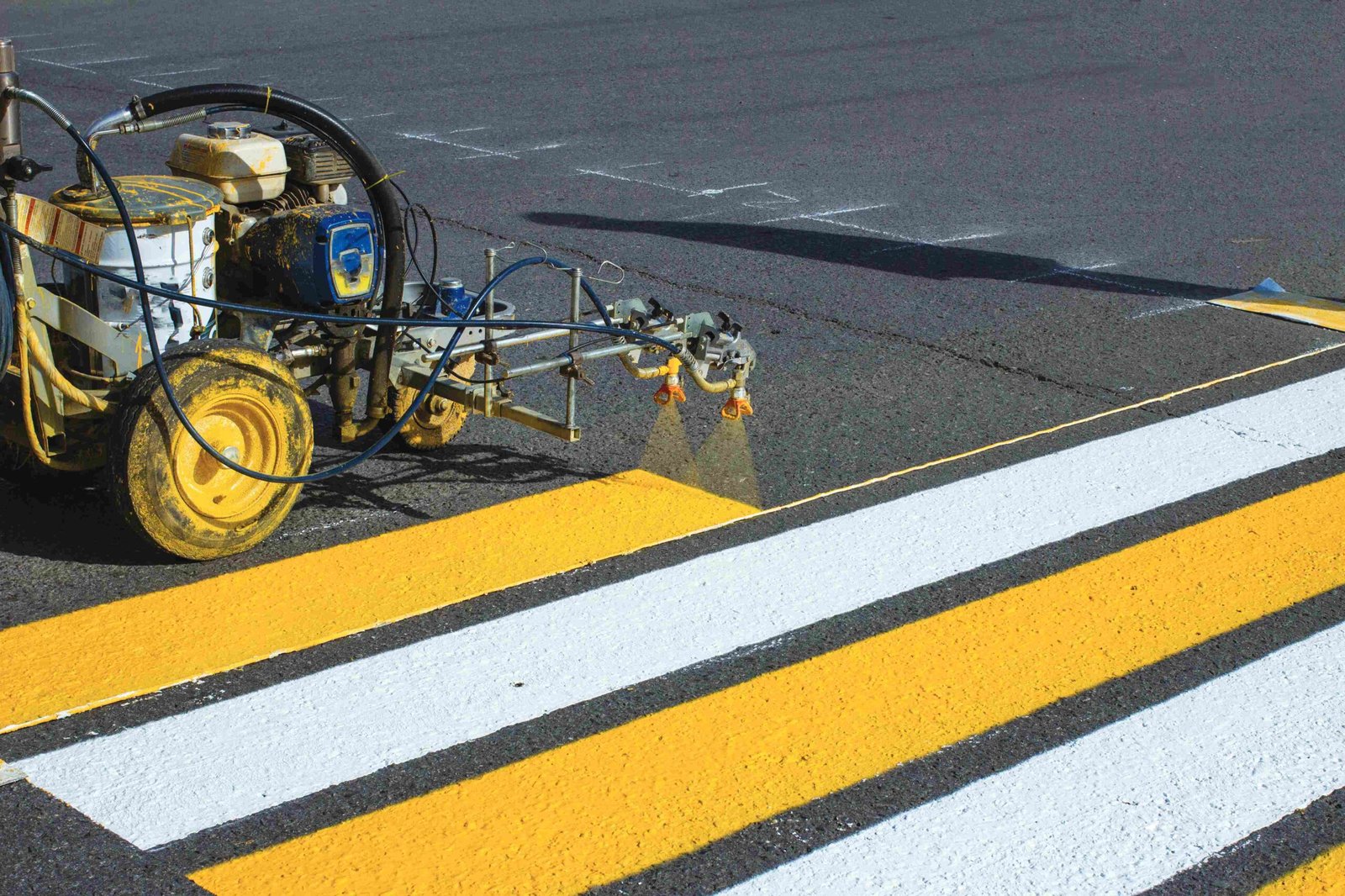
Parallel to these material innovations, the machinery used for application is also advancing. Given the urgency of road projects and rising safety requirements, there is an increasing emphasis on deploying automated road-marking machines capable of delivering rapid, uniform and precise applications.
Thermoplastic road markings, which remain the dominant choice in many countries including India, are progressively being applied through such automated systems rather than traditional manual push-behind applicators. While automation requires upfront capital investment, the consistency, speed and quality achieved through these machines significantly outweigh the costs in the long run.
As India continues to scale its road infrastructure at an unprecedented pace, the adoption of these global best practices—both in terms of advanced materials and precision-driven application technologies—will be critical to ensuring safety, sustainability and durability on our roads.
Kataline has over two decades of experience in road markings for multiple applications
With over two decades of experience in road marking applications, Kataline has steadily grown by putting user feedback, road safety and continuous quality improvements at the forefront of its work. Our journey has been defined by a strong commitment to in-house research and development, investment in advanced testing facilities, automation-led production and capacity expansion. At the same time, we place equal emphasis on enhancing the skills of our application teams—equipping them with both knowledge and modern machinery to deliver world-class results.
We are proud to have pioneered several firsts in India. Among these are cold-applied plastic wide-area markings for coloured and theme-based pedestrian crossings, horizontal signages and junction improvement initiatives tailored to improve both safety and aesthetics. In the domain of speed-calming measures, we developed single-application transverse bar markings in cold-applied plastic, capable of thickness ranging from 5 mm to 50 mm, offering an effective and durable traffic calming solution.
Our specially formulated profiled thermoplastic materials are another milestone, designed to provide shape retention with thickness up to 11 mm, in monolithic application. These markings offer both audible and tactile warnings, reducing the risk of run-off-road collisions and improving overall driver awareness.
Beyond materials, Kataline has remained strongly aligned with the Make in India vision. Over the years, we have consistently introduced innovations across safety-related domains—ranging from black spot remediation and school zone safety to sustainable urban drainage systems, passive fire protection coatings and anti-carbonation paints.
How technology has evolved..
At Kataline, our approach is strongly aligned with the UN’s Safe Systems philosophy, which recognises human fallibility and the need to design safer systems around it. We focus on creating customised, evidence-based solutions to address diverse road safety challenges. Factors such as road user behaviour, traffic density, vehicle speeds and changing vehicle dimensions shape our approach, prompting us to deploy in-house teams dedicated to surveying, analysing and collaborating with road authorities both in India and abroad. This allows us to consistently provide fast, efficient, and cost-effective outcomes.
The growing adoption of AI-driven technologies has also influenced our processes. We have successfully integrated AI-based systems into our manufacturing and logistics operations. These enable our automated production facilities to monitor quality in real-time, ensure consistency and deliver faster project turnarounds. This digital transformation is not only improving reliability but also helping us establish benchmarks for precision and repeatability in the industry.
We actively work with leading road safety experts and educational institutions, conducting in-depth studies to capture road user experiences and vehicle interactions. These insights feed directly into enhancing the effectiveness of our systems and the practical usability of our innovations on Indian roads.
Underpinning all of this is a strong investment in advanced material sciences and state-of-the-art machinery, which ensures our solutions remain ahead of the curve in both performance and durability. By blending human-centred design, AI-driven systems and rigorous scientific research, we are striving to shape the next generation of road safety solutions for India.
The segments where Kataline products and equipment have been making a difference..
Our efforts are firmly rooted in addressing the most critical safety needs of commuters, road authorities and maintenance agencies by developing interventions that balance innovation, practicality and long-term reliability. In India, as well as across our growing international markets in Africa, the Middle East, South America and Australia, Kataline solutions have consistently made a difference.
Key impact areas include improved commuter navigation through consistent and durable road markings, traffic calming measures, including advanced transverse bar markings, structured markings and profiled studs that guide safer driving behaviour. The other areas are road safety for Vulnerable Road Users (VRUs) with safer pedestrian crossings, school zone interventions and cycle-friendly corridors.
Enhanced night-time visibility enabled by high-performance retroreflective materials; structured systems for wet and low-light conditions; sustainability-linked domains, where we provide anti-carbonation coatings and sustainable urban drainage systems (SuDS) that improve infrastructure resilience are other impact areas.
Passive fire protection systems are a critical area where our coatings and materials help shield infrastructure and facilities from fire hazards, creating safer urban environments that go beyond roads to buildings and transport nodes.
For airports, Kataline provides advanced machinery and materials for highly precise runway and taxiway markings. In ports, the customised marking and coating solutions capable of withstanding harsh marine conditions ensure safety and efficiency in high-demand operational areas. This multi-sector presence reflects our guiding philosophy: “Marking Every Journey Safe” — by land, air, or sea.
Challenges in this segment considering Indian conditions and standards
India’s rapidly expanding road network faces significant challenges in road marking quality and durability due to diverse traffic volumes, varying road types, harsh climatic conditions and inconsistent lane discipline. These factors often result in premature wear of markings, reduced visibility and compromised road safety, despite regulatory standards. Budget constraints and fragmented responsibilities further exacerbate the problem.
The solution lies in the Quintet Approach, which brings together five critical stakeholders—manufacturers, applicators, government monitoring agencies, contractors and consultants—to work in harmony. Manufacturers ensure high-quality, tested materials. Applicators apply markings with precision using best practices and modern equipment. Government agencies enforce standards and conduct quality monitoring. Contractors coordinate the project seamlessly, ensuring compliance and documentation. Consultants design markings based on global best practices adapted to local conditions and supervise their implementation.
Importance of road markings for road safety..
Road markings play a fundamental role in assisting, informing, controlling and guiding all road users. It is crucial to distinguish between ordinary road markings and performing road markings—those that remain clearly visible during the day and highly reflective at night, thus fulfilling their intended purpose effectively.
Regulatory markings such as edge lines, centre lines and directional arrows serve as essential navigational aids that guide drivers safely along their routes. For enhanced safety, especially to warn drowsy drivers and prevent run-off-road accidents, specialised profiled and structured road markings generate tactile vibrations and sound, combined with improved night-time visibility.
Wide-area coloured road markings have multiple benefits: they break the monotony of long drives, highlight crossings for vulnerable road users such as pedestrians and cyclists, enhance the aesthetics of the roadway and provide early warnings of speed limits from greater distances.
Transverse bar markings, designed with a single application and parabolic geometry, play a highly effective role in reducing vehicle speeds without sudden jerking and driver discomfort, addressing critical speed management concerns and road user requirements.
Empirical studies indicate that horizontal road signages enhance driver attention and can positively influence driver behaviour, reducing the likelihood of accidents. Performing road markings are key enablers in this respect, as they provide the clear, consistent visual cues and feedback necessary for safer driving decisions.
Offerings from Kataline at Trafficinfratech Expo 2025
Our focus will be on presenting comprehensive solutions tailored to enhance road safety, traffic management and sustainable infrastructure development across India and export markets. Visitors can explore how our automated production technologies ensure consistent quality and rapid project turnarounds, supported by our commitment to safety-centred training through the Kataline Centre of Excellence.
Additionally, Kataline will showcase its latest innovations in performing road marking materials, including high-performance thermoplastics enhanced with advanced glass beads for superior visibility and durability. Our cold-applied plastics and profiled road marking systems offer effective traffic calming, speed reduction and enhanced safety for vulnerable road users.
Our materials and machinery comply with international standards like MoRTH, AASHTO, and BSEN, tailored for India’s unique road and climatic conditions.
We also bring our efforts in sustainable infrastructure, including solutions for anti-carbonation coatings, passive fire protection and sustainable urban drainage systems (SuDS), to support resilient and future-ready projects.