


Page 27 - TT July Issue for Digital Edition
P. 27
ROAD SAFETY


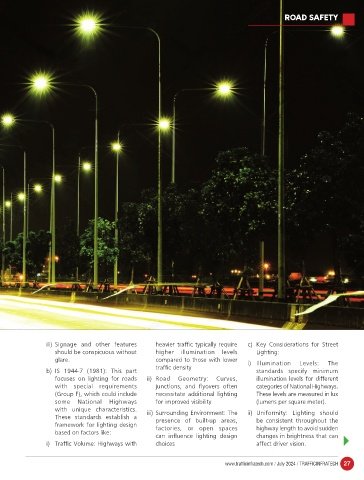
                iii) Signage and other features     heavier traffic typically require   c)  Key Considerations for Street
                   should be conspicuous without    higher illumination levels        Lighting:
                   glare.                           compared to those with lower   i)  Illumination  Levels:  The
                                                    traffic density
                b)  IS 1944-7 (1981): This part                                       standards  specify  minimum
                   focuses on lighting for roads   ii)  Road Geometry: Curves,        illumination levels for different
                   with special requirements        junctions, and flyovers often     categories of National Highways.
                   (Group F), which could include   necessitate additional lighting   These levels are measured in lux
                   some National Highways           for improved visibility           (lumens per square meter).
                   with unique characteristics.   iii) Surrounding Environment: The   ii)  Uniformity: Lighting should
                   These standards establish a      presence of built-up areas,       be consistent throughout the
                   framework for lighting design    factories, or open spaces         highway length to avoid sudden
                   based on factors like:
                                                    can influence lighting design     changes in brightness that can
                i)  Traffic Volume: Highways with   choices                           affect driver vision.


                                                                           www.trafficinfratech.com / July 2024 / TRAFFICINFRATECH  27

