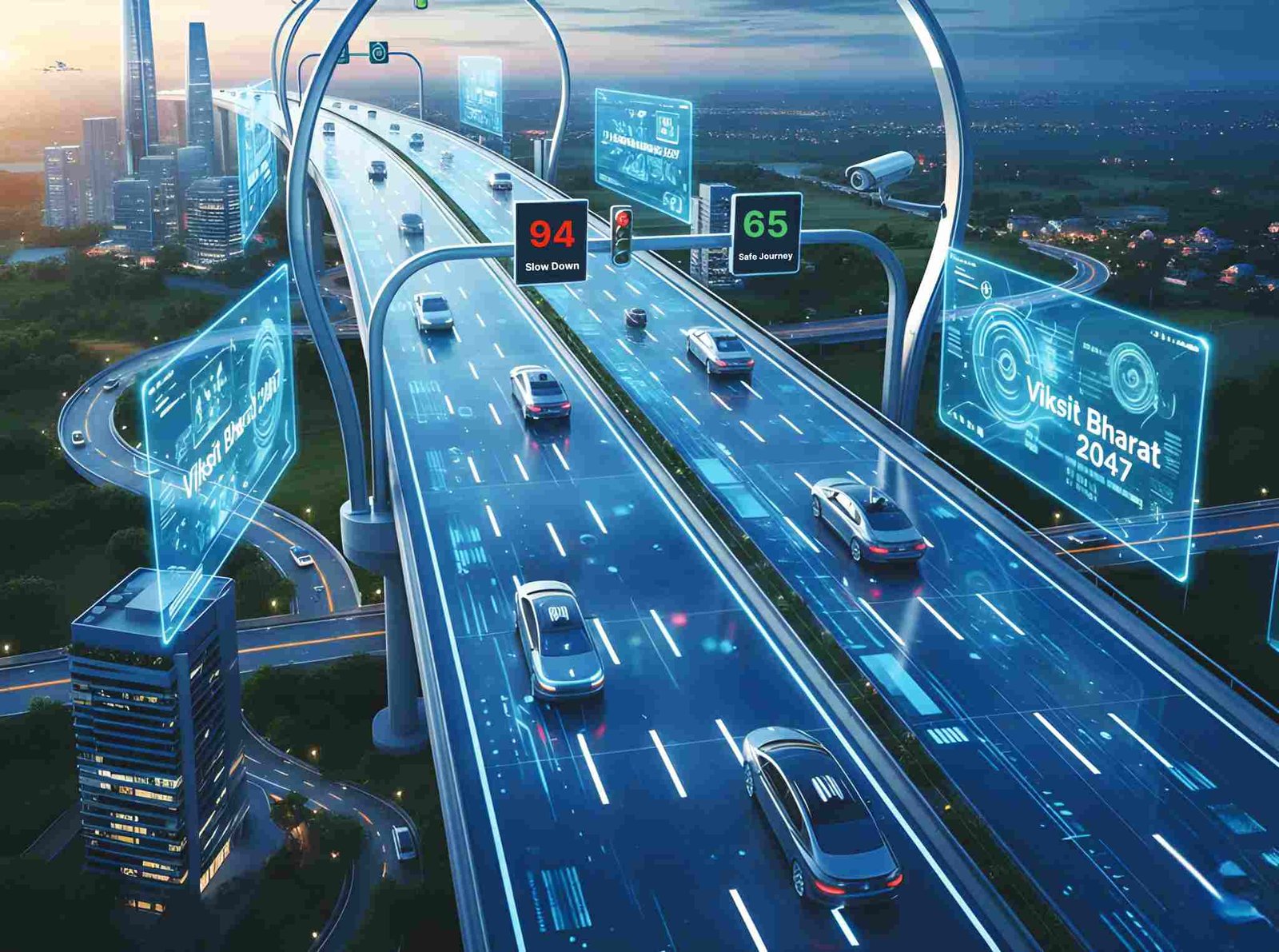
To realize a $30 trillion economy, transportation must evolve from fragmented, reactive systems to integrated, intelligent networks. According to Anand Shankar, Director – Planning & Advisory, DataCorp Traffic Pvt Ltd, the integration of ITS is central to building world-class infrastructure needed to support India’s economic ambitions.
Today, India faces pressing challenges: over 180,000 annual road fatalities, rising congestion, and billions lost to delays in our cities. In metro cities alone, residents lose hundreds of hours each year in traffic, reflecting how bottlenecks can constrain innovation and growth. To realize a $30 trillion economy, transportation must evolve from fragmented, reactive systems to integrated, intelligent networks. The integration of ITS is central to building world-class infrastructure needed to support India’s economic ambitions.
As India sets its sights on becoming a developed nation by 2047, the vision of Viksit Bharat calls for more than economic expansion. It requires a transformation of our national infrastructure. At the heart of this transformation lies transportation, the backbone of mobility, productivity and growth for 1.45 billion citizens.”
— Anand Shankar

Arterial Traffic Management Through Corridor Intelligence
Modern transportation challenges require surgical precision in management. Traditional approaches of viewing roads as standalone entities must evolve toward understanding transportation networks as interconnected ecosystems. The key lies in breaking major corridors into smaller, manageable segments where technology can monitor, analyse and optimize traffic flow in real-time.
Vehicle Actuated Control (VAC) signalling represents a significant advancement in this direction. Unlike traditional fixed-time signals, VAC systems use artificial intelligence to dynamically adjust signal timing based on real-time traffic volume. These systems continuously monitor traffic patterns, compute optimal signal timings and implement them dynamically while coordinating with adjacent signals to ensure smooth traffic flow.
Real-time Violation Detection and Congestion Management
The integration of AI-powered camera systems for traffic monitoring addresses multiple challenges simultaneously. Advanced traffic management systems (ATMS) can now detect multiple violations, from illegal parking and encroachments to speeding and red-light violations. This comprehensive monitoring capability is crucial for India, where behavioural issues significantly contribute to traffic congestion.
Illegal parking alone can reduce road capacity anywhere between 10 to 30% in urban areas. When intelligent cameras detect unauthorized parking, they don’t just record violations, they immediately alert traffic management centres, enabling rapid response. Similarly, pothole detection systems can automatically notify maintenance crews, preventing the cascading effects of road deterioration on traffic flow.
Encroachment monitoring is equally critical. Many Indian roads suffer from gradual space reduction due to unauthorized extensions of shops, vendor stalls, or construction materials. AI-powered surveillance can detect these encroachments in real-time, providing authorities with the data needed for swift corrective action.
The Path Forward: Scalable Implementation Strategies
The vision of Viksit Bharat requires transportation solutions that can scale across diverse Indian conditions, from dense urban corridors to the vast rural highways connecting agricultural regions. This demands flexible deployment models that support both on-premises and cloud-based processing, adapting to varying levels of digital infrastructure maturity.
Advanced traffic management systems must be designed to grow organically. A small town can begin with basic ANPR-enabled traffic monitoring and gradually incorporate AI-powered signal control, environmental sensors and predictive analytics as infrastructure and capacity develop.
Enabling Economic Growth Through Technology
Transportation technology’s contribution to Viksit Bharat extends far beyond traffic management. Efficient transportation systems enable just-in-time manufacturing, reduce inventory costs, and improve access to markets for agricultural products. The economic multiplier effects of investing in intelligent transportation infrastructure are substantial.
Innovation Ecosystem Development
The push toward intelligent transportation creates opportunities for indigenous innovation. From developing AI algorithms optimized for Indian traffic conditions to creating low-cost sensor technologies suitable for diverse climatic conditions, the transportation technology sector can become a significant contributor to India’s innovation ecosystem.
Conclusion: Enabling Viksit Bharat
The vision of Viksit Bharat is not just about achieving economic metrics, it’s about creating an India where technology serves citizens, infrastructure enables prosperity, and innovation solves complex challenges. In transportation, this means moving beyond traditional approaches to embrace intelligent, data-driven systems that can adapt, predict and optimize in real-time.
The technologies exist today to transform India’s transportation landscape. AI-powered traffic management, digital twin-enabled infrastructure planning, comprehensive monitoring systems, and predictive analytics can address the challenges that currently constrain our economic growth. The question is not whether these technologies can work in India, but how quickly can we deploy them at scale.