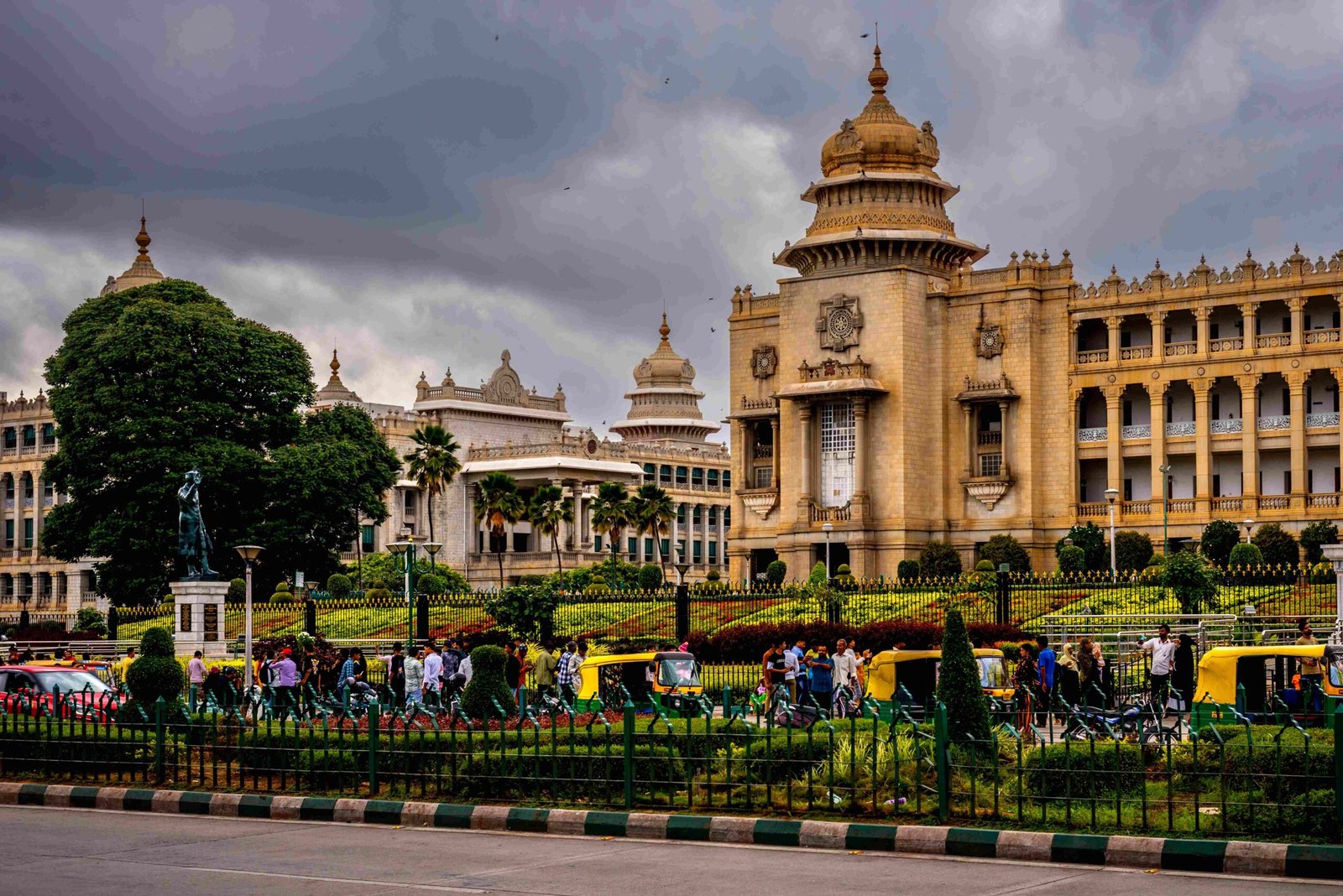
Bengaluru’s infamous traffic chaos has long been India’s most cited urban challenge. Now, with an AI-based Mobility Digital Twin (MDT) project underway, the city might soon be able to visualize, predict, and manage congestion before it happens. The question is — can technology really outsmart gridlock?
Can Technology Help Fix the Traffic?
AI and Digital Twin technologies have been quietly transforming traffic management and urban planning worldwide — and Bengaluru is no exception.
AI-enabled cameras already capture 87% of traffic violations, while adaptive signals have reduced waiting times by up to 22%.
The new AI-based MDT aims to bring these fragmented systems together. By modelling the entire city digitally, Bengaluru can monitor live traffic flows, simulate potential diversions, and make predictive decisions in real time.
Yet, as Rajesh Krishnan, CEO of ITS Planners & Engineers Private Limited, cautions:
“The context within which digital twins are deployed is important, without which the technology will be just another novelty which will fall by the wayside when a new fad takes over.”
Read: Digital Twins for Smarter & Safer Roads
AI + Digital Twins: Complementary Capabilities
AI finds patterns amidst millions of data points. Digital Twins visualize impact, estimate outcomes, and simulate scenarios.
As Christopher Kettell, Chief Technologist at TRL, notes,
“AI can be extremely helpful in sifting through large amounts of data and making sense of it – differentiating trends from outliers.”
Rajesh adds,
“DTs can estimate traffic on the entire modelled road network, including links that don’t have sensors, using flows from a smaller number of links. Hence DTs can reduce the cost of sensor deployment.”
Together, they enhance decision-making rather than replace it — a crucial distinction for a city as complex as Bengaluru.
Building the Digital Ecosystem
The upcoming MDT will integrate commuter behaviour, vehicle tracking, dynamic infrastructure maps (junctions, metro points, parking zones, roadworks) with live updates — weather, accidents, public events, citizen apps, and enforcement databases.
For traffic police, this means better planning for diversions during VIP movements, dynamic alerts to public transport during protests, and identifying repeat offenders across the city.
The system will also leverage Bengaluru’s existing traffic infrastructure:
- BATCS – Bangalore Adaptive Traffic Control System
- ASTraM – Unified traffic management platform
- Traffic Management Center (TMC)
- AI Cameras, Drones, and User-based Apps
Case Study: Smart Traffic Infrastructure Delivery with Project Controls
The Next Leg of Transformation
In the initial phase, Bengaluru has digitally simulated around 3,200 km of its 14,000 km road network, covering key high-density corridors and arterial routes.
The long-term plan involves integrating data from BMRCL, BMTC, and mobility aggregators for a unified, predictive citywide model.
Once fully operational, the MDT will become a live decision-support system — predicting congestion, testing alternative routes, and modelling the effects of new infrastructure projects.
Beyond Transport: Data for Smarter Cities
According to ABI Research, cities worldwide could save up to $280 billion by 2030 by using digital twins for more efficient urban planning.
For Bengaluru, the MDT isn’t just about smoother roads — it’s a testbed for Smart City evolution. Data collected from sensors, smartphones, and citizen platforms can help plan:
- Multi-modal mobility hubs
- EV charging infrastructure
- Paid parking zones
- New bus stops and last-mile systems
These simulations allow planners to test changes virtually — reducing risks of project delays or cost overruns.
Read: Maha Metro: The Digital Twins
EVs, ESG & Sustainability
Sustainability remains one of the strongest outcomes of AI and Digital Twin adoption. Cities can identify pollution hotspots, track EV adoption, and plan charging infrastructure intelligently.
Projects like Helsinki 3D+ show how integrating urban data can reduce emissions and enhance commuter comfort.
Bengaluru’s MDT could play a similar role — addressing bottlenecks, on-street parking, and road safety through data-driven, real-time decisions.
AI and Digital Twins promise a shift from reaction to prediction — from firefighting congestion to preventing it.
If Bengaluru can align its agencies, infrastructure, and citizens under one connected platform, the city may finally see traffic management that moves as fast as its technology sector.
Compiled by Vaishnavi Achari, Communications Executive, TrafficInfraTech