
It is interesting to note that the much-maligned tyres of vehicles in accidents on expressways accused of ‘bursting’ are less to blame because of over speeding or overheating than of poor maintenance by automobile owners. Tyres are neither glamourous nor attention-seeking but the bedrock providing the interface between the vehicle and the road. Sudershan S. Gusain, Chairman – ATMA Tyre Safety Awareness Group, elaborated on technology and the efforts to reduce misinformation about tyres in general.
India’s Automotive Tyre Manufacturers’ Association, a representative body of six large tyre companies accounting for over 90% of the country’s tyre production, has dedicated itself towards promoting and safeguarding the interests of the sector primarily by acting as a conduit between the Government and the industry.
“The tyre is a black box and people are not aware of the reality. In India, manufacturers make tyres where the average speed is H-rated, i.e. the tyre has a maximum speed rating of 130 mph or 210 km/h and is designed to safely handle speeds up to this limit. Even though it is mandatory to check your tyre speed rating, it really does not matter because you are not going to do 210 km/h on Indian roads. One misinformation is that Indian tyres are not suitable for high speeds but obviously tyre bursting on highways has nothing to do with the quality of tyres, which are compliant with ISI requirements.
“The ISI standard was created by combining the best of the quality requirements from European and American standards and around 25% of tyres manufactured in India are exported. If the mandated speed on an autobahn is 180 km/h and our tyres burst well below that, how are they selling in Europe? Therefore, it is not the product but the way we maintain our tyres that needs attention. Our tyre safety awareness programs focus on four parameters of Pressure, Alignment, Rotation and Tread (PART). Once you take care of this, you are more or less done. This is very basic, not rocket science.”
Pressure
Tyre is a flexible structure filled with compressed air. Inflation pressure plays an important role in carrying the vehicle load and is vital for the safe use of tyres. Under or over inflation may lead to tyre failures for vehicles. The right amount of air for tires is specified by the vehicle manufacturer and is shown on the vehicle door edge. It is also listed in the owner’s manual. Air pressure must be measured in a ‘cold’ condition.
There are three likely scenarios for inflation observed in tyres: under, over and recommended inflation. When tyres are inflated below the recommended inflation pressure, the condition is said to be under-inflation. It increases tyre wear, creates excessive heat and causes the sidewalls to over flex. This leads to the tyre’s premature failure.
When the tyre is inflated higher than the recommended inflation pressure, the condition is said to be over-inflation and such tyres can cause suboptimal vehicle handling performance leading to lowering safety levels. It also makes tyres susceptible to impact damages. Recommended inflation maintains an even ground contact pressure of the tyre tread and prevents uneven wear. It ensures safe driving, riding comfort and monetary savings.
Alignment
Alignment of the wheel refers to the proper setting of the axle geometry as well as tracking of all axles on a vehicle. The purpose of the alignment is to minimize tyre wear, maximize predictable handling and driver control and safer vehicle operation. Alignment is to be checked periodically and it is also recommended that tyre wheel assembly be checked for proper balancing.
Rotation
Rotation of tyres regularly is to prolong tyre life by achieving more uniform wear of all tyres on a vehicle. Rotating the tyres as recommended by the vehicle or tyre manufacturer will help even out the amount of wear on each tyre and extend the life of entire set. There are many best practices available for tyre rotation and these differ for types of vehicles such as cars, trucks, buses, tractors etc.
Tread
Tread-wear indicators (TWI) mean the projections within the tread grooves designed to give a visual indication of the degree of wear of the tread. Tyres with Non-Skid-Depth (N.S.D.) less than 0.8mm for two and three-wheeler tyres and 1.6 mm for other motor vehicles tyres are unsafe to drive and worn beyond these limits are not fit for use. Every tyre has bars in the main grooves and indicators in the shoulder region on at least six locations around the circumference. Different manufacturers use different symbols to indicate TWI.
ATMA makes all categories of tyres including for autorickshaw, scooter, motorcycle, forklift, car, SUV, truck & bus, aeroplane, agriculture and off-the-road. Within each group are Radial and Bias tyres and radial can be both tube type and tubeless whereas BIAS can be tube-type only.
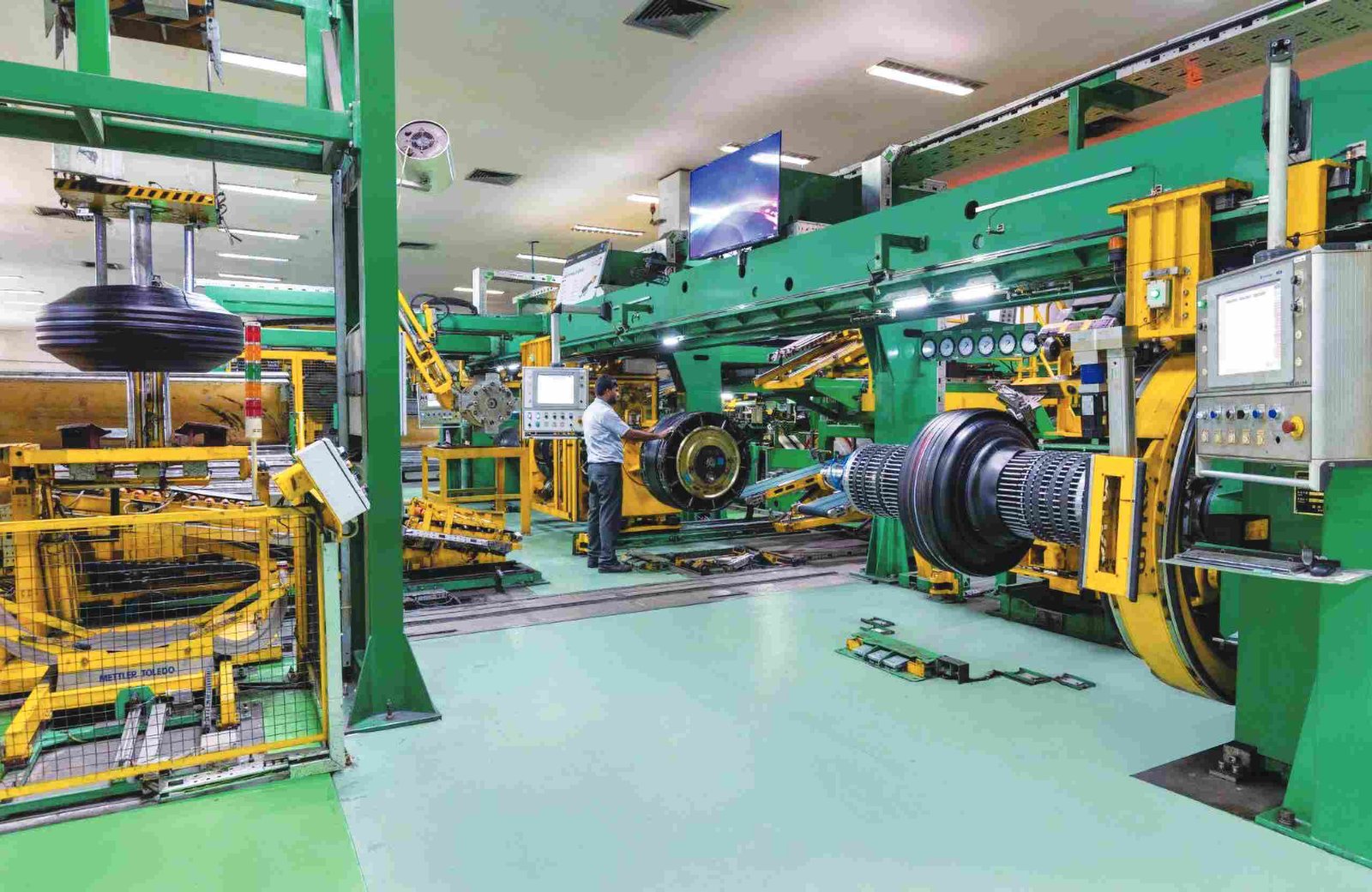
According to Gusain, tyre manufacture is a complex process. Its components include the Bead – the part of the tyre, which is so shaped as to fit the rim and hold the tyre on to it. It has cores made of several strands of essentially inextensible steel wire with the end of the plies wrapped around the cores for anchorage. The Sidewall is the part of the tyre between the bead and the tread, which flexes in service.
The Tread is the part of the tyre which comes in contact with the ground and through which the driving, braking and cornering forces are transmitted. It is made of a special rubber compound to give good wearing properties and in conjunction with the tread pattern to transmit these forces. The ply, carcass, breaker and belt or radial are other key components of the tyre.
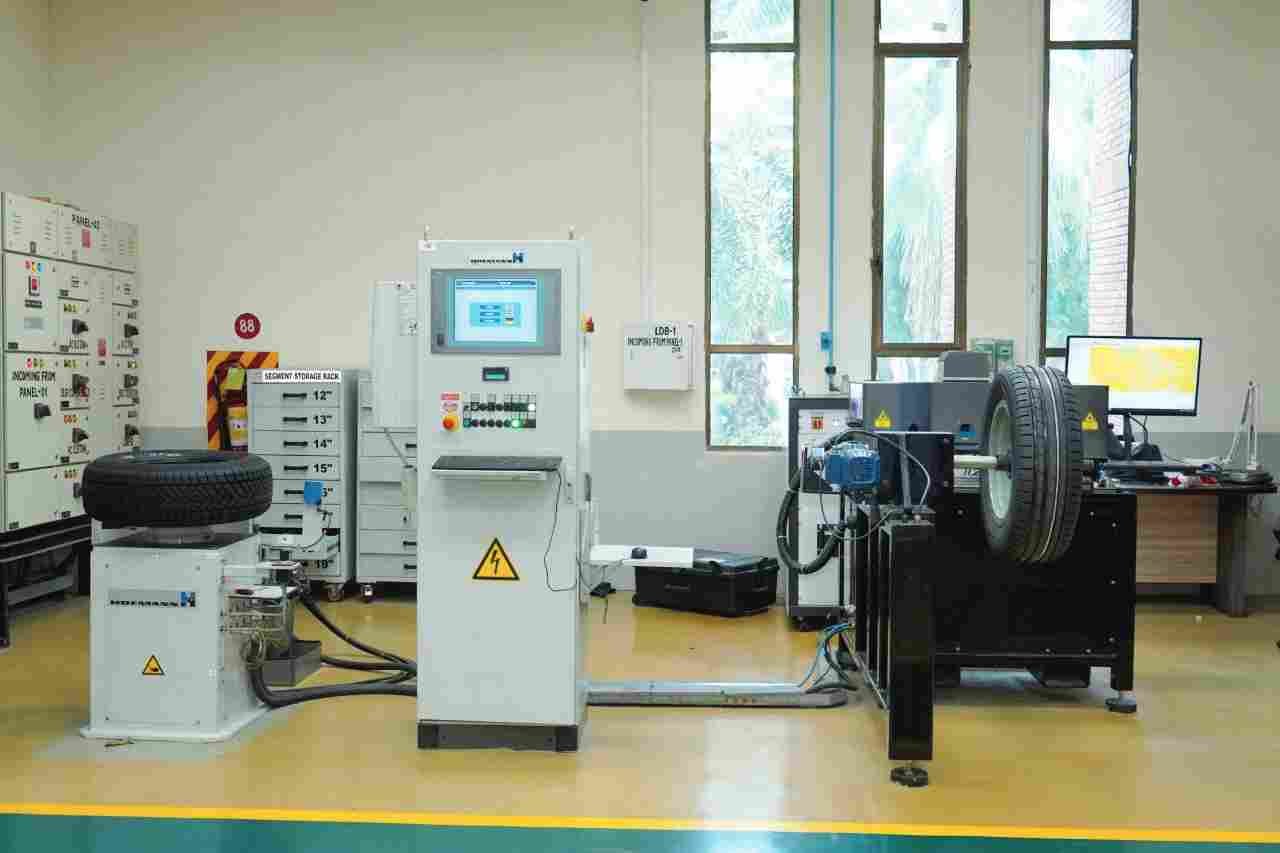
“Each child part is prepared separately, batch processed and then put together in a mould and curing is done involving temperature, pressure and time. While temperature and pressure are more or less the same, the curing time is different. Car tyres require 15 minutes of curing, truck tyres almost an hour, tractor tyres maybe four hours and off-the-road tyres, the whole day. After the tyre is produced, we do some tests such as unbalancing, uniformity and visual as also for strength, speed and durability as per BIS standards.

“Accident data shows tyre related cases over a decade from 2011 to 2023 that of 7148 accidents, 74 were caused due to tyre damage which is 1% of total number of accidents. It is also interesting to note that among vehicle types which caused accidents due to tyre damages, car owners were most careless in maintaining their vehicle tyres whereas truck owners were more conscious.
“An average car has five tyres, each costing `6,000. A truck has 11 tyres, each costing `30,000. Every time a truck halts, one guy will immediately jump down and remove stones from the tread. He knows the value of a tyre. Truck tyre pressure is better maintained.
“Sustainability means different things for different people such as long life of tyres, fuel efficiency, sustainable materials and less resources. Government regulation requires rolling resistance, wet grip and noise as sustainability checks. Manufacturers are improving sustainability at every stage including procurement and transport of raw materials, manufacture, usage, end of life and recycling.
“The government is promoting circular economy and from 2024-25 onwards has mandated 100% recycling on new tyres manufactured / imported from 2022-23. The modality of the Extended Producer Responsibility (EPR) regime has assigned weightage based on type of recycling. The highest weightage has been assigned to Rubber Reclamation, followed by Recovered Carbon Black, Crumb Rubber Modified Bitumen (CRMB) and Crumb Rubber, which can be used in road construction and making footwear respectively. Pyrolysis and Char extracted from continuous and batch pyrolysis methods have the least weightage as they cause pollution on burning.
“We conduct safety awareness group activities such as seminars, webinars and ideathons, data collection via tyre checks and quizzes, safety advocacy to traffic police and associations such as CII, SIAM, ARAI and tyre education for the government, corporates, academia and the general public. Our campaigns are still not reaching the masses as we lack funds. MoRTH just allows us to use its logo. We still have a long way to go.”