Amsterdam is in the news for the world’s largest first underwater bike garage in the heart of the city, a parking structure that can store 7,000 bicycles in a submerged facility at the central train station. The Stationsplein bicycle garage at the front of Amsterdam Central Station is part of a sophisticated infrastructure project to modernize the station in the Dutch capital. There is also a new metro station which quickly transports travellers to the city’s outskirts and a tram stop nearby for a city tour. This cycling infrastructure project in Amsterdam has been in the works for four years.
The new underwater garage makes an end to the messy and overflowing bicycle parking facilities in front of the Amsterdam central station, says a report. It’s tucked away out of sight beneath the clear waters and pleasure boats. Bikes can be parked freely for 24 hours and then at a cost of €1.35 for the next 24 hours. The bicycle detection technology uses optic sensors and a smart software algorithm that is able to simultaneously detect up to 20 bicycle parking slots. The system will detect available spaces. Green and red lights are shown to indicate if parking spaces are available or not.
The two-tier bicycle rack allows to store bicycles one above the other, thus doubling storage capacity. The system uses integrated gas springs to provide assistance when lifting bicycles to the upper level. Similar projects will soon be realised in Europe as cycling becomes more popular in the world.
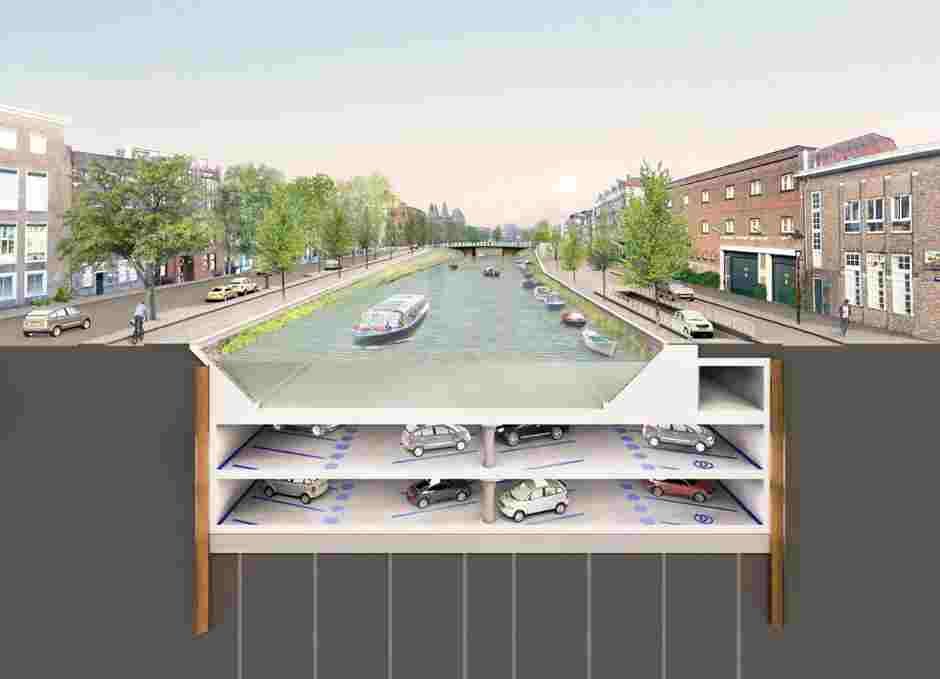
This innovation however, comes years after the city built the Albert Cape Underwater Garage right under the Amsterdam canal back in 2018 for parking 600 cars, located on two levels under the Berenwetering Canal, intended primarily for use by permit holders. There is also parking for 60 bicycles in the garage. The idea behind this is that permit holders use their bike to drive to the garage to pick up their car.
The municipality of Amsterdam sought to improve the quality of life and accessibility of the city by creating more areas for pedestrians, cyclists, children playing and greenery. To achieve this, the city took several measures to reduce the number of cars in the city and create car-free districts. The De Pijp neighbourhood in Amsterdam was built during the last decades of the nineteenth century and was not designed to accommodate a large quantity of cars. Residents did not want to give up their cars but also wanted a neighbourhood that offered a comfortable atmosphere with enough opportunities to play outside and go for an unobstructed stroll.
Sixty of the 600 parking places in the underground garage are reserved for visitors of the neighbourhood, the remaining are for residents of De Pijp who have a parking permit. To house that many vehicles, two levels of parking space over a length of 260 meters were created. Access and exit were made easy and transparent in such a long and narrow space by creating long ramps against the outsides to provide straightforward and one-way traffic. To use the width of the garage as efficiently as possible the cars are parked under a 70-degree angle. The oval columns are also placed under the same angle giving pedestrians and drivers a lively and rhythmical visual effect, according to published reports.
The cobalt blue way finding in lines and pictograms also supports this, making sure that orientation is quick and easy. The ceilings are smooth as most of all cables and ducts are incorporated in the concrete, providing a quiet and transparent feeling. There are no shady corners in this garage. The glass pedestrian entrances and the long ramps allow maximum daylight to enter into the garage, which contributes to a feeling of safety and pleasantness.
The idea behind this design by ZJA is to blend the parking garage into the existing urban landscape. All installations are installed out of sight and the ramps are integrated into the existing quays without conspicuous elevations. It is simple and safe, visually unobtrusive and maintains the quality of the public space for pedestrians and cyclists optimal. The entrances and elevators are modest in size and transparent. Since the parking system in this garage remembers which license plate is parked in which slot, it also qualifies as a smart garage. The real intelligence, however, according to the architects, is hidden in the fact that not a square foot of city has been sacrificed to house 600 cars so that the residents and visitors of De Pijp can enjoy more spacious, greener and quieter streets. Wonderful!
Compiled from various sources