


Page 38 - TT Aug-Sept pdf for digital
P. 38
TOLLING


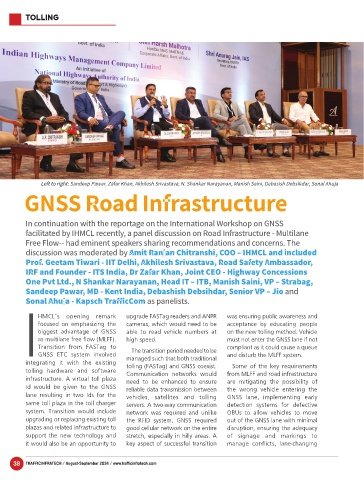
               Left to right: Sandeep Pawar, Zafar Khan, Akhilesh Srivastava, N. Shankar Narayanan, Manish Saini, Debasish Debsikdar, Sonal Ahuja
         GNSS Road Infrastructure


          In continuation with the reportage on the International Workshop on GNSS
          facilitated by IHMCL recently, a panel discussion on Road Infrastructure - Multilane
          Free Flow-- had eminent speakers sharing recommendations and concerns. The
          discussion was moderated by Amit Ranjan Chitranshi, COO – IHMCL and included
          Prof. Geetam Tiwari - IIT Delhi, Akhilesh Srivastava, Road Safety Ambassador,
          IRF and Founder - ITS India, Dr Zafar Khan, Joint CEO - Highway Concessions
          One Pvt Ltd., N Shankar Narayanan, Head IT – ITB, Manish Saini, VP – Strabag,
          Sandeep Pawar, MD - Kent India, Debashish Debsihdar, Senior VP – Jio and
          Sonal Ahuja - Kapsch TrafficCom as panelists.

              HMCL’s opening remark        upgrade FASTag readers and ANPR   was ensuring public awareness and
              focused on emphasizing the   cameras, which would need to be   acceptance by educating people
              biggest advantage of GNSS    able to read vehicle numbers at   on the new tolling method. Vehicle
              as multilane free flow (MLFF).   high speed.                  must not enter the GNSS lane if not
              Transition from FASTag to                                     compliant as it could cause a queue
                                            The transition period needed to be
          I GNSS ETC system involved       managed such that both traditional   and disturb the MLFF system.
          integrating it with the existing   tolling (FASTag) and GNSS coexist.   Some of the key requirements
          tolling hardware and software    Communication networks would     from MLFF and road infrastructure
          infrastructure. A virtual toll plaza   need to be enhanced to ensure   are mitigating the possibility of
          Id would be given to the GNSS    reliable data transmission between   the wrong vehicle entering the
          lane resulting in two Ids for the   vehicles, satellites and tolling   GNSS lane, implementing early
          same toll plaza in the toll charger   servers. A two-way communication   detection systems for defective
          system. Transition would include   network was required and unlike   OBUs to allow vehicles to move
          upgrading or replacing existing toll   the  RFID  system,  GNSS  required   out of the GNSS lane with minimal
          plazas and related infrastructure to   good cellular network on the entire   disruption, ensuring the adequacy
          support the new technology and   stretch, especially in hilly areas. A   of signage and markings to
          it would also be an opportunity to   key aspect of successful transition   manage conflicts, lane-changing


     38   TRAFFICINFRATECH / August-September 2024 / www.trafficinfratech.com

