
Since the development of automated vehicles (AVs), many experts in the transportation industry have stated that one of the biggest benefits will be improving mobility for disadvantaged travelers (e.g., elderly, persons with disabilities, low-income individuals). However, many of those statements did not identify what is necessary to make AVs improve mobility – is it just that these vehicles will be self-driving or are there other vehicle features that will facilitate mobility? Upon further investigation, having AVs available to disadvantaged travelers will not automatically make any improvements – there is a need to ensure that travelers accept and trust this type of technology before examining other needs of disadvantaged travelers. Carol Schweiger, President, Schweiger Consulting LLC, writes for Trafficinfratech
Stepping back for a moment, when examining intelligent transportation systems (ITS), such as AVs, with an equity lens, there are three major perspectives to consider:
- ITS design and deployment has, in the past, often overlooked culture, gender, physical ability, and ability to access and use technology. While this has led to wasted time, diminished safety and increased costs, it has highlighted the fact that technology development must solicit input from all people of all ages and abilities. Obtaining this input can be challenging due to some specific groups not being easy to reach.
- The equity of technology-enabled mobility services (such as AVs) must be identified, including the definition of key equity dimensions and metrics, and development of mobility equity frameworks.
- Data generated, analyzed and used by ITS technologies may result in societal or ethical issues. Data may not be impartial since the data may be used in a way that can create biases.
So how will AVs improve the mobility of disadvantaged travelers given these perspectives? In August 2022, the US Federal Transit Administration conducted a study of the practices and ongoing research on accessible public transportation automation. The key findings of this study are described in the following table.
| Technologies | Findings | |
| Boarding and Alighting Technologies | Ramps and lifts are essential for accessibility, with ongoing research into automated systems that can operate without transit personnel | Kneeling technologies are being developed to adjust to the surrounding environment, reducing ramp slopes |
| Securement Technologies | Current systems often require personnel assistance, but semi-automated devices allow wheelchair users to secure themselves independently | Research is ongoing for universal docking interfaces and automated securement systems |
| Wayfinding and Communication Technologies | Technologies are being developed to assist passengers with disabilities in locating bus stops, identifying vehicles, and communicating with the vehicle | Features like tactile alternatives to audio announcements and direct connections to hearing aids are being explored |
However, there are several challenges and limitations associated with these technologies. Many technologies are still in early development stages, and retrofitting existing vehicles for accessibility often faces design, regulatory and financial challenges. Further, onboard personnel are currently essential for providing accessible services, as fully automated solutions for all accessibility needs are not yet mature.
This study identified what is necessary in the future in order to ensure the accessibility of AVs:
- Automation could enhance AV accessibility, such as precision docking for level boarding, improving mobility device securement systems, and freeing onboard staff to focus on customer service.
- Collaboration and co-creation with the disability community is necessary to identify the accessibility challenges and test solutions associated with AVs.
- Accessible AVs are still in prototype stages. Current approaches include retrofitting inaccessible AVs or adding automation to accessible bus platforms.
- Onboard staff are still being used for accessibility tasks like ramp deployment, wheelchair securement, and customer assistance. While the future is moving toward unstaffed operations, this presents significant technical and policy challenges.
- The wide variety of vehicle platforms, service types, and rider characteristics require tailored accessibility solutions. For example, smaller vehicles such as AV shuttles face space constraints if a traveler is in a wheelchair.
- Better data is needed to understand AV acceptance and expected AV usage by persons with disabilities and other disadvantaged travelers.
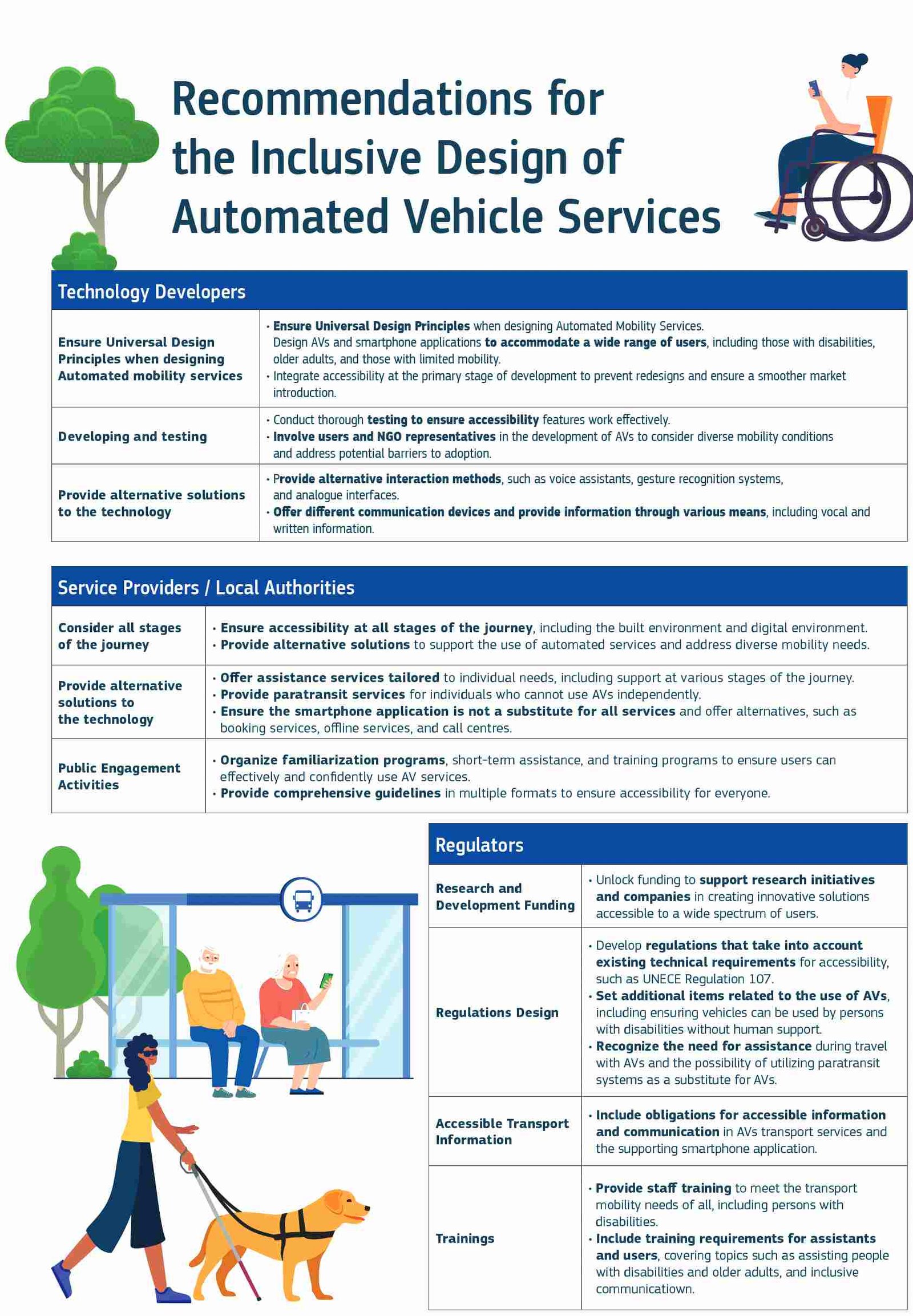
From the European perspective, recent research conducted by the European Commission investigated the accessible design of AVs. “This report provides insights into the requirements for developing accessible AV services, including both the vehicle and the supporting smartphone application. Specifically, it addresses the design of the vehicle itself (i.e., access, exit, and internal and external interactions), the smartphone application supporting its use (i.e., including technical and informational features), training programs to facilitate service adoption, and the need for assistance.”2 The recommendations resulting from this research are summarized in the following table.
As mentioned earlier, as we examine AVs from an equity lens, addressing the accessibility of AVs is only one part of equity. AVs must be accessible to all travelers which requires overcoming the following additional challenges:
- Underrepresentation of Disadvantaged Groups: Policies often overlook low-income individuals, people of color, and rural communities, risking reduced access to transportation.
- Interpersonal Security: Safety concerns in shared AVs may deter vulnerable populations like women, transgender individuals, and racial minorities.
- Economic Displacement: Automation threatens jobs in the driving sector, disproportionately affecting low-income workers and people of color.
- Rural Accessibility: Shared AV models may be inefficient in low-density rural areas.
- Environmental Justice: Increased vehicle miles traveled (VMT) and emissions could harm low-income and minority communities.
- Cost Barriers: High costs of AV technology may limit access for economically disadvantaged groups.
- Digital Divide: AV reliance on advanced technology may exclude those without digital access.
- Urban Planning Impacts: AVs could lead to urban sprawl, worsening inequities in areas with limited infrastructure.
- Policy Gaps: Current regulations may not adequately address equity concerns.
However, once these challenges are addressed, AVs have the potential to improve mobility for all travelers in an equitable manner:
- Shared Mobility Models: Promoting shared AV use can reduce costs.
- Integration with Multimodal Transportation: Supporting transit, walking, and cycling alongside AVs can create equitable networks.
- Rural and Suburban Access: AVs can connect underserved areas to urban centers.
- Sustainability Initiatives: Mandating electric AVs can reduce emissions and promote more environmentally-friendly travel.
- Community Involvement: Engaging marginalized groups in decision-making and co-creation ensures that AV designs reflect their needs.
- Technological Adaptations: Designing AVs for inclusivity, such as accommodating disabilities, can enhance equity.
- Data-Driven Equity: Leveraging data can address transportation gaps and ensure equitable service distribution.
By actively considering equity in the design, development, and deployment of AVs, stakeholders can work towards harnessing the potential benefits of this technology to create a transportation system that is safe, efficient, and accessible to everyone.