
Prof. P. Rajalakshmi, CYIENT Chair Professor (Future Communication) and Director – NMICPS TiHAN Foundation, Department of Electrical Engineering, Indian Institute of Technology, Hyderabad, writes on the urgent need for advanced driver-assistance systems and autonomous driving technologies tailored to Indian conditions.
Department of Science and Technology (DST), under the National Mission on Interdisciplinary Cyber-Physical Systems (NM-ICPS), has sanctioned the prestigious Technology Innovation Hub (TIH) in the technology vertical of Autonomous Navigation and Data Acquisition Systems (UAVs, ROVs, etc.). Technology Innovation Hub on Autonomous Navigation (TiHAN) at IITH is a multi-departmental initiative, including researchers from Electrical Engineering, Computer Science and Engineering, Mechanical and Aerospace Engineering, Civil Engineering, Mathematics, Design, and Entrepreneurship at IIT Hyderabad, with collaboration and support from reputed institutions and industry.
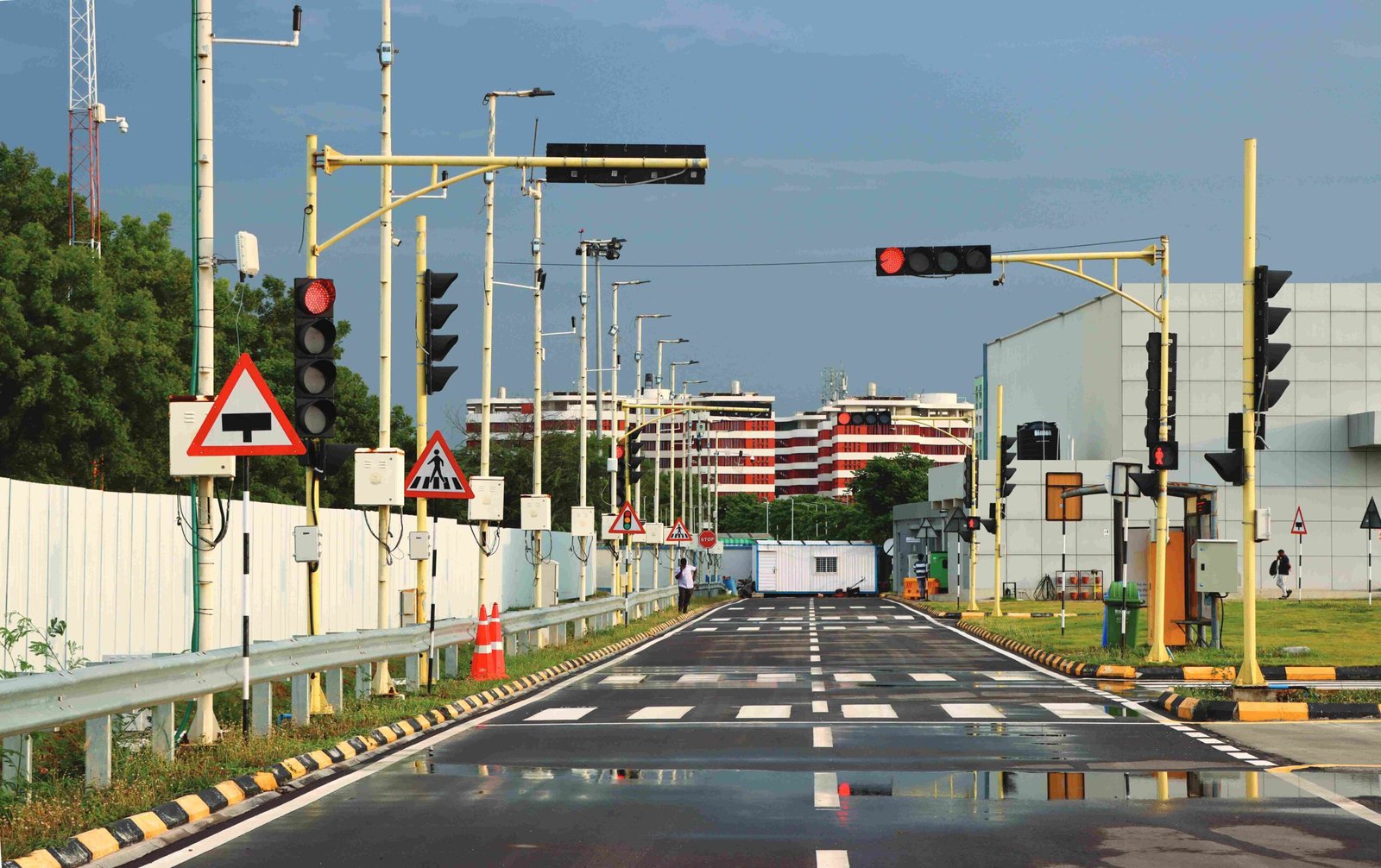
As part of the project, a first-of-its-kind integrated testbed on Autonomous Navigations (Aerial/Terrestrial) is being set up on the IITH campus which has state of the art facilities such as Proving Grounds, multi radio enabled Test tracks, Mechanical integration facilities like Hangers, Ground control stations, State of the art Simulation tools (SIL, MIL, HIL, VIL), Test tracks/circuits, Road Infra – Smart Poles, signalized & unsignalized Intersections, Environment Emulators like Rainfall Simulators, V2X Communications, Drone Runways & Landing area, Drone Control Test centre.
Key Research Directions:
- Driver Assistance (ADAS): Automatic Emergency Braking (AEB), Lane Departure Warning (LDW), Traffic Sign Recognition (TSR), Blind Spot Detection (BSD), Driver Monitoring Systems (DMS).
- Autonomous Driving (AD): Campus shuttles, industrial park vehicles, geo-fenced autonomous transport.
- India-specific datasets: Capturing real-world scenarios such as animal crossings, jaywalking, wrong-way driving, and pothole avoidance.
Technology Development of ADAS/AD
Technology development of ADAS and Autonomous Driving (AD) for Indian roads demands solutions that can handle the country’s unique complexity and unpredictability. At the core of this development is a robust sensing and perception layer, which fuses inputs from cameras, LiDAR, radar, and GNSS/INS to provide 360-degree awareness in diverse weather and lighting conditions.
Complementing this is localization and mapping, where lightweight, adaptive maps, combined with V2X communication, ensure reliability even in GNSS-challenged areas. Prediction and planning modules play a critical role in modelling multi-agent interactions—whether it is two-wheelers weaving through traffic, sudden pedestrian crossings, or right-of-way ambiguities—and in designing risk-aware motion strategies. Control systems are engineered for resilience, enabling vehicles to handle low-traction surfaces, abrupt braking, and speed humps common on Indian roads.
Onboard computer platforms, built with ROS2-based modular software and real-time middleware, support scalability, seamless updates, and over-the-air (OTA) readiness. Equally important is human–machine interaction, where driver monitoring and intuitive alerts are designed to fit the driving culture in India, ensuring trust and safe adoption of these technologies.
Testbed Facilities
TiHAN’s proving ground is the first-of-its-kind facility in India, designed to provide controlled yet realistic environments for testing safety-critical functions in autonomous and driver-assistance systems. The testbed replicates diverse driving conditions—from urban zones with intersections, roundabouts, pedestrian crossings, and unmarked lanes, to highway segments equipped with lane splits, glare simulation, and barriers.
Rural roads are also emulated with low-marking lanes, potholes, and shoulder usage to capture challenges unique to Indian conditions. Dynamic surfaces such as wet pads, gradients, and rumblers further test vehicle stability and control. Complementing these physical environments is a 5G-enabled connectivity corridor with V2X roadside units that support real-time communication experiments.
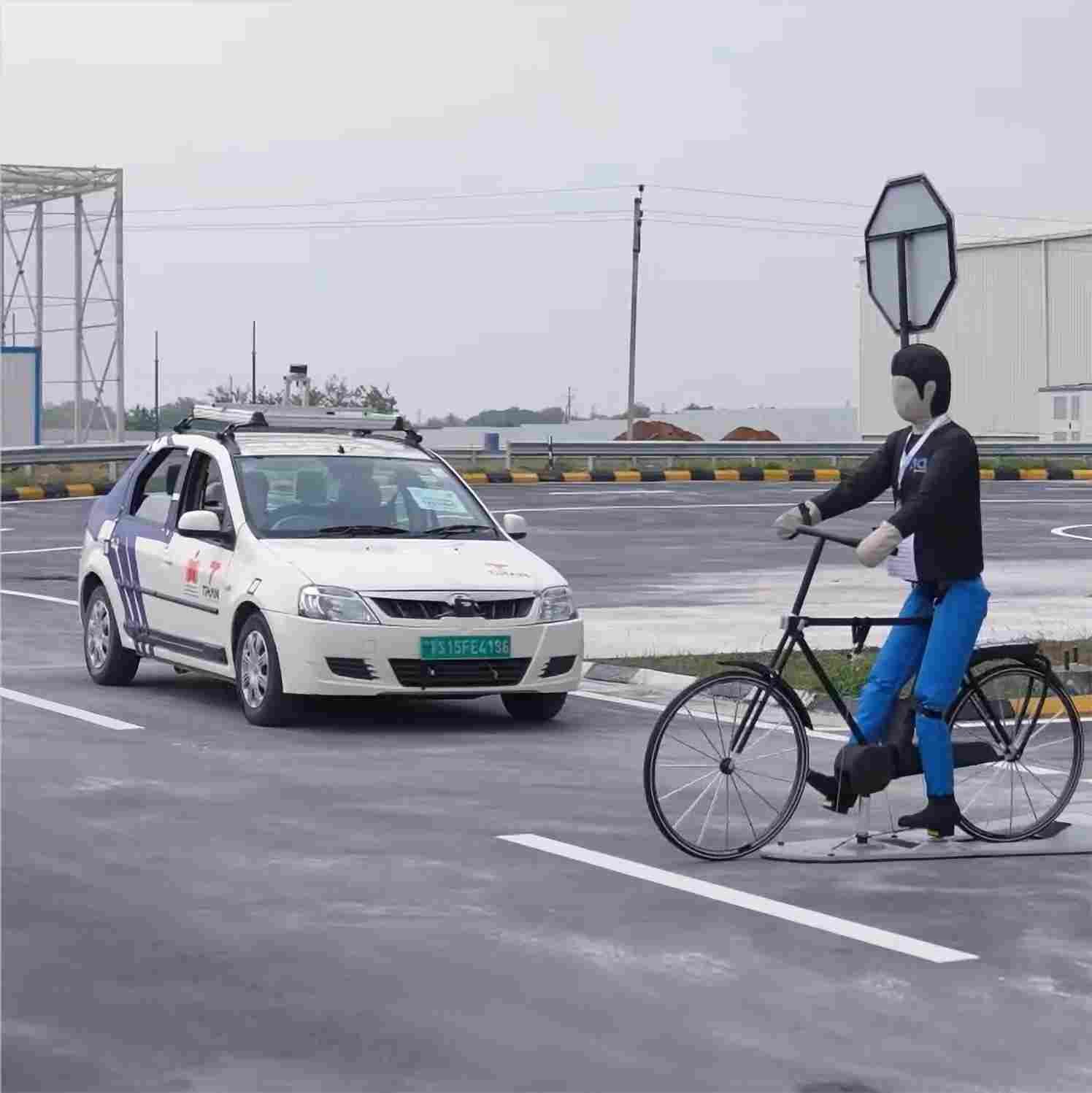
To ensure safety in critical trials, the facility also employs soft targets, including pedestrian and vehicle dummies, allowing repeatable and risk-free testing of Automatic Emergency Braking (AEB), collision-avoidance, and related ADAS functions..
Testing & Validation
Safety validation ensures that advanced driver-assistance systems and autonomous driving technologies are reliable in real-world Indian conditions. To support robust system development, the hub conducts multi-sensor data logging, building rich datasets for perception training and validation. This process is further strengthened through simulation-in-the-loop, where high-fidelity digital twins of test tracks and representative Indian city environments allow accelerated testing of rare and critical events.
Finally, there is emphasis on repeatable validation using robotic actors and soft targets, enabling reproducible safety assessments under controlled conditions. Together, these efforts create a comprehensive framework for testing, validating, and improving road safety technologies for India.
Equally important, TiHAN aligns all its R&D with international and Indian standards to ensure that validation results are not only rigorous but also globally benchmarked. The framework includes ISO/UNECE for connected and autonomous vehicle compliance. This dual focus—India-specific scenario validation coupled with adherence to international standards—ensures that the developments meet the highest levels of safety while remaining relevant to local regulatory requirements.
Autonomous Campus Shuttle Deployment:
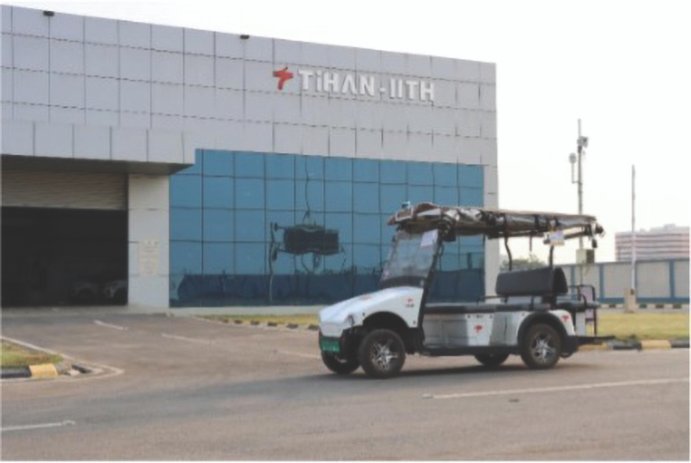
Autonomous Campus Shuttle showcases a novel cutting-edge technology, offering a convenient and efficient mode of transportation within the campus premises. The vehicle employs AI-driven multi-sensor fusion, incorporating LiDAR, INS/GNSS, and camera inputs, to achieve environment perception, mapping, localization, and autonomous navigation. The vehicles have obstacle detection capabilities for both short and long range. The vehicle was already deployed in the IIT Hyderabad campus since August 2023 for the students and staff movement and received positive feedback. Passenger safety is utmost priority and the passengers are ensured a secure and pleasant experience