 India’s road network has expanded by 59 percent in nine years. It has built around 64 lakh km of roads since 2013-14, adding 34 km of highways per day, the highest recorded after China. It is imperative, therefore, to have regular, comprehensive safety audits of all roadways and educate drivers on road safety and lane discipline. TrafficInfratech explores various aspects of road safety audits from its evolution to its adoption and impact on Indian roads with inputs from experts in the field, including Dr. S.Velmurugan, Chief Scientist and Head, Traffic Engineering and Safety Division, CSIR–CRRI.
As per the Manual for Safety in Road Design (India), Road Safety Audit (RSA) is defined as a formal procedure for assessing accident potential and safety performance in the provision of new road schemes, the improvement and rehabilitation of existing roads and in the maintenance of existing roads. It is said to combine art with science – the art of assessing how road users will use the road and the science of proven road safety engineering principles. The objectives of an RSA are to ensure high levels of safety on new road projects, reduce their whole-life costs, minimise accident risk on the adjoining road network, promote the safety of all road users and enhance road safety engineering.
We had made a commitment in 2020, when the figure was 1,50,000 deaths per year, to reduce it to 50% by 2030. But considering our traffic mix, traffic behaviour, way of attending to fatalities and with people continuing to drive in an erratic manner and also with road-user education being rather poor, I think there will be an increase in road fatalities and serious injuries by 2030 rather than a reduction.
– Dr S Velmurugan
-
- BEFORE
-
- AFTER
Evolution, adoption and Vision Zero
“The road safety audit per se is a process which was evolved by traffic engineers in the UK way back in 1989”, said S. Velmurugan. “It came about purely by accident when they saw that some of the newly developed roads were appearing in the black spot list. The reason they found was that specific targeted road users’ concerns are not getting addressed during the design stage. They decided to go for road safety audits at specific stages in order to address the concerns of the type user who drive on those roads. For e.g., their motorways needed to be audited by one who understood that the targeted road user would be motorized traffic only.”
“That audit process was adopted slowly and steadily across the globe. UK started it and subsequently Sweden took it in a very big way, by having Vision Zero”, added Velmurugan. Sweden introduced the concept of Vision Zero in 1997 and it is based on the principle that it can never be ethically acceptable that people are killed or seriously injured when moving within the road transport system.
While earlier concepts expected that road users bear complete responsibility for safety, Vision Zero changes this relationship by emphasizing that responsibility is shared by transportation system designers and road users. Human mistakes cannot have fatal consequences. “Vision Zero does not mean reduction of crashes but zero deaths. Unfortunately, many people in India try to use it as Zero Crashes”.
When India decided to join the UN Decade of Action for Road Safety 2021-2030 in 2011, the government had already implemented the golden quadrilateral and NSEW corridor projects, among others. Since 2014, massive road development projects like the Bharatmala Pariyojana for national highways, PMGSY (for rural roads development), state highways and urban roads have grown rapidly.
The poor quality of construction was evident when even newly-paved roads developed huge potholes and caused major accidents. Mumbai’s new trans-harbour link, the Atal Setu built at a cost of Rs 18,000 crore, had become a mess of craters in its very first monsoon. It was reported that the Comptroller and Auditor General has said that the Bharatmala Pariyojana was being built with innumerable deficiencies and non-compliance of outcome parameters, among others.
Audit process
“Road safety audits are being made mandatory beginning with the BOT (Build, Operate, Transfer) projects. The road owning agency like the NHAI or State government will collect toll for the redemption period. However, toll collection can only begin once the road is declared safe and fit for operation. This was brought out as a legislation by NHAI. Out of the 6.6 million kms, these BOT and HAM (Hybrid Annuity Model) projects are not more than 45,000 kms, the remaining being EPC projects which also have to be taken care of. RSA has to be done at various stages including the design stage.”
According to Velmurugan, any road which is 5kms or more should undergo one time audit at the design stage, a mandatory requirement brought out by a Supreme Court ruling in 2017 in this regard. If a road is getting widened from a single lane to a 2-lane, 2-lane to a 4-lane or from a 4-lane to a 6-lane, a new green-field alignment to an expressway or a new national highway itself, then the design audit is to be done one time followed by construction audits at regular intervals and finally, the pre-opening audit. The pre-opening audit has to be certified by the consultant appointed by the road-owning agency and only then can the agency start levying toll. This has been mandatory for all National and State Highway and PMGSY projects.
“For PMGSY projects, audits need to be conducted only during the design stage because of paucity of funds and more importantly, lower speed of not more than 40kmph. If the design is proper and there is not much traffic coming in, one audit is considered adequate for rural roads. For urban roads, it is taken up on a case-to-case basis. Over and above the design, construction and pre-opening, audits are also conducted in the O&M stage, usually taken up on roads which are experiencing high rates of crashes or having plenty of black spots.
-
- BEFORE
-
- AFTER
Implementation and recommendation
“Based on our knowledge at CRRI, the implementation of these audits is rather poor – be it at design, construction or O&M stages. Some suggestions are classified by the road user as change of scope and either the right-of-way or funds are not available resulting in the implementation of only 50% to 70% of the audit recommendations. A road safety audit in principle says you need to show compliance. But the real problem in India is we do not show it in the proper way.”
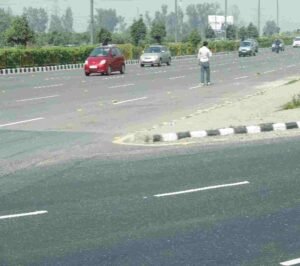
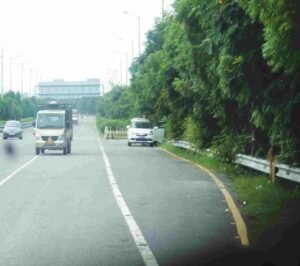
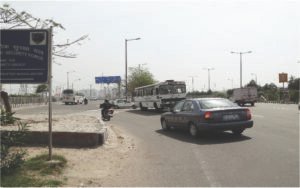
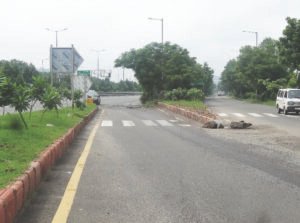
Most of our expressways do not have major design issues, added Velmurugan. CRRI conducted an RSA on the Noida-Greater Noida Urban Expressway which is a 24 km limited corridor. It starts on the outskirts of Delhi and NOIDA is the starting point. We audited 20 of the 24 kms way back in 2012 and they implemented up to 60% of our recommendations. Three years down the line, we studied how much of that implementation had been effective and we found the fatality reduction to be a very substantial 30% and serious injuries reduction almost 40%. The corridor investment done by NOIDA generated an RoI of 23%.
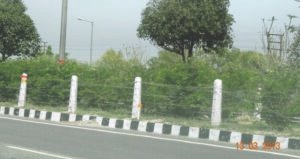
Some of the key audit recommendations included providing two rows of Metal Beam Crash barrier (MBCBs) in flush with the inner edge of the raised median by replacing the concrete guard posts which were fortified barbed wire fencing raising safety concerns for errant vehicles and providing auxiliary lanes, chevron marking and erection of channelizers before and after merging or diverging.
Also recommended were three Foot Over Bridges for pedestrians and road markings on the carriageway coupled with designation of each lane for various modes including an emergency lane. It was also found necessary to augment the width of the service road considering the huge residential and institutional development on either side of the corridor and to provide retro-reflective studs along both the edges of the service road at regular intervals.
Monitoring of traffic flow through the installation of CCTV cameras coupled with Variable Message Sign (VMS) boards, installation of speed enforcement cameras to aid in monitoring traffic condition, communication to road users on the traffic situation and automatic issuance of speeding tickets were other recommendations.
-
- BEFORE
-
- AFTER
Certification and review
Audits are performed by a minimum of two members. Unlike in the developed world where a non-engineering major with adequate audit experience can become a team leader supported by a traffic or a highway planner with an engineering background, the requirement for a team leader in India is BE Civil Engineering having conducted five road safety audits with at least three during the design stage and undergone the 15-day certification program conducted by IRC or CRRI. Others in the audit team could be enforcement specialists or non-engineering members.
“While CRRI itself has only eight to nine auditors, we have developed 992 till date through our 15-day certification program. These auditors, in turn, can train others in their organisations. Based on the Ministry’s recommendation, a three-member committee was formed by the Supreme Court on Road Safety headed by a retired Supreme Court judge with additional members including one expert from CRRI and a retired Secretary from MoRTH. The committee reviews the road safety performance of state governments every six months to evaluate the extent of implementation and how it is commensurate with the reduction in fatalities and serious injuries.”
Sri Lanka is a good example of a country similar to India in terms of problems faced but the kind of traffic discipline followed by the people entering from minor roads on to the highways with no violations is noteworthy. India has excellent documentation but falls short on implementation whereas Sri Lanka does not have any documentation but has implemented all the requirements directly from the UK manual. “There has to be a cultural transformation, only then we will see better things happening for Indian roads,” stated Velmurugan