 TrafficInfraTech Magazine Linking People Places & Progress
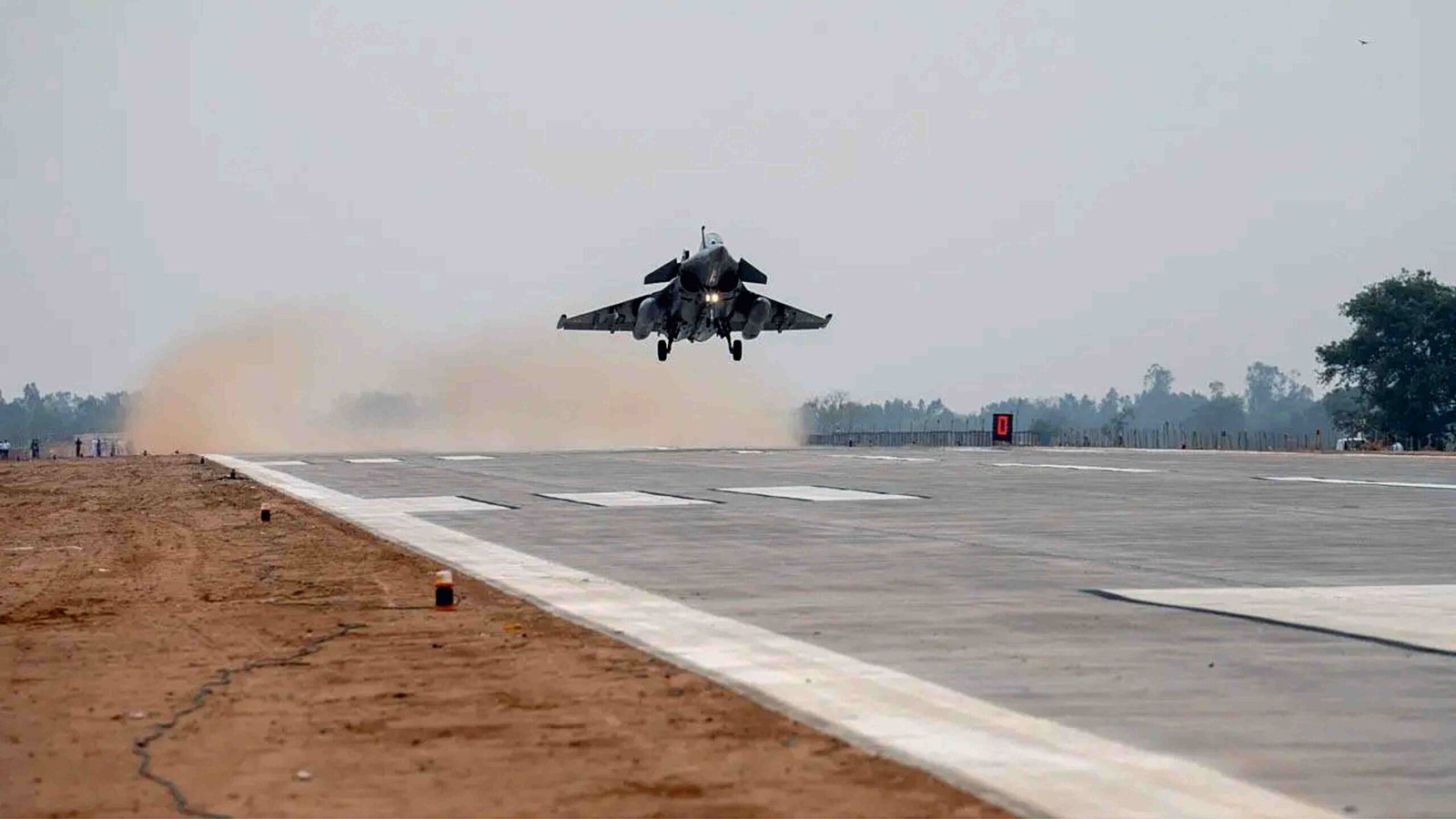

Operation Sindoor affirmed the need for strong infrastructure facilities during peace time as well during war or war-like situations. A nation is only as strong as its civil infrastructure, which must always remain functional. A country’s added advantage is when some facilities are made for dual use by both civilians and military during active conflicts and emergency situations. Since the Indian Air Force can provide a swift response, it is crucial that primary airbases are ably supported by secondary ones and this can be achieved through integrating additional facilities with existing civil infrastructure. Suvra Chakrabarti, Chief Engineering Manager – Traffic & Road Safety, Transportation Infrastructure IC, Larsen & Toubro Limited, shares with TrafficInfratech this deeply engrossing concept and how it has been adopted and implemented in India.
Arrangement of traffic control devices on Bangarmau airstrip of Agra-Lucknow expressway was given a deceptively simple look even though it is a dual facility. That was the challenge wherein lies the initiative’s success. This was to ensure that vehicular traffic was not unnecessarily alarmed during regular highway operations. Aircraft, on the other hand, were given suitable guidance to safely manoeuvre as well, thereby addressing the need of two diverse types of users under very different circumstances.
– Suvra Chakrabarti
Though the need for dual facilities was identified several decades ago, mainly in the developed countries such as the USA; however, it is a relatively new concept in India.
An IAF jet landing/take off was successfully carried out on Yamuna Expressway in UP in 2015 as the first such publicly declared event in India. A Mirage 2000 landed on the expressway near New Delhi to demonstrate that the most modern Indian highways can meet the need for such facilities in the future. However, the stretch of Yamuna Expressway where the event was held was neither designed nor constructed as a designated runway. It was a relatively straight one having regular traffic control devices such as vehicular pavement marking (edge lines, lane lines), raised kerb and shoulder-side metal beam crash barrier. The selected stretch did not have the treatment required for runways, specifically the necessary runway pavement markings and clear widths.
A year later in 2016, a suitable straight stretch of Agra-Lucknow expressway near Bangarmau – UP, still in the construction phase, was selected to be designed as a secondary airfield or runway for use by IAF during emergencies. It is India’s first-ever dual facility by design.
India’s first dual facility by design
Even though the IAF jet landing of an expressway had happened a year ago, there was no integration of the design requirements of the required runway facility at the conceptual level of Agra-Lucknow expressway project. It was added as an infrastructure requirement after the project was awarded. Specific codes and guidelines did not exist for a dual facility at that time and prevailing codes for highway design did not specify details either. However, stringent requirements of the IAF were made available to design and construct the country’s first ever dual facility. These documents have restricted access for public consumption.
Here we are talking about traffic control requirements to run the roadway during regular operations and dual facility, with Bangarmau airstrip as an example. It also presents a need for a set of standards that is required to be established to develop more facilities for dual usage at strategic locations.
Readiness in terms of civilian vehicular traffic on diversion roads parallel to runway during operations is something that needs to be addressed in the same guideline while being fully aware that in an active conflict situation, civilian movement can severely be restricted or strictly prohibited. After Bangarmau airstrip, many locations across the nation were selected for design and construction of dual facility.
Designs consideration for traffic control, traffic safety and road furniture of any road infrastructure project typically follows the project’s technical specifications and prevailing codes and guidelines by Indian Roads Congress. Design of traffic control and safety devices in India is based on various IRC codes, such as IRC:67 for signages, IRC:35 for pavement markings and four lane and six lane highways and expressway manuals along with various safety codes and MORTH guidelines. Furthermore, international codes such as AASHTO, MUTCD, and DMRB are referred for design enhancement wherever necessary.
For runway design, ICAO Annex 14 is the universal standard for aerodrome design and operations. Further, IAF’s own guidelines specify requirements for runway/airstrip facilities. However, currently, there is no integration of highway and airfield design manuals, guidelines or standards in India. Various requirements are integrated into a set of actionable points as design basis for project specific cases.
All types of motorized vehicles such as cars, buses and trucks generally permitted on Indian roads are allowed to ply on the select stretch of dual facilities. The design of pavement of the runway is not governed by the type of vehicles but for higher loading. However, it is imperative that the facilities on the select stretch cater to all types of vehicles. The select stretch of dual facilities are ideally capable for operations of various types of military aircraft currently in use by the IAF. Rafale, Mirage 2000, Sukhoi, MiG, C1300J Super Hercules and various combat helicopters have been able to use the dual facilities.
Design development of Bangarmau airstrip
The 5-km long Bangarmau airstrip, a straight stretch of road on the Agra-Lucknow expressway, was selected as it was suitable to be constructed as the country’s first dual roadway/runway facility. The expressway operates like all other high-speed vehicular facility. However, the runway portion can be taken over by the IAF based on emergency operational and training needs. During peace time, the expressway, including the airstrip, operates as a high-speed corridor for vehicles. At times of adversity, such as a war or a rescue mission, vehicles on the main carriageway of the expressway can be guided to a safe diversion road running parallel to the airstrip that is specifically constructed for this purpose.
Entry of vehicles into the airstrip will be completely restricted by way of installation of barricades that can be installed within a few minutes. Permanent traffic control and traffic safety devices on the expressway were designed and installed in such a way that the change from road to runway can be made possible within a short time, typically within a few hours according to standard operating procedures.
Challenges…
There were design challenges of course. Standard codes and guidelines for dual road/runway design did not exist in India. Design specifications of the IAF are confidential in nature and had restricted circulation policy and this posed as a challenge to the engineers designing and constructing the dual facility. Pavement design and the appearance of the constructed surface of the pavement was significantly different from the adjacent expressway pavement before and after the stretch. In this case, the entire expressway was flexible pavement whereas the designated airstrip pavement was rigid pavement and appeared lighter coloured surface from aerial view.
Additional right-of-way (land) was required on both sides of the full length of the designated stretch for running parallel diversion roads. Additional land was also required on both ends of the runway for emergency aprons, for aircraft parking usage. Design had to consider that civilian activities on airstrip would stop completely at times of adversity and they would be guided to a safe parallel route, called diversion road.
This specific requirement was ensured by designing appropriate exit ramps from the expressway main carriageway to the specific diversion road before start of the runway stretch and entry ramp from the diversion road back on to the expressway after the runway stretch ended.
No elevated structure could be constructed in and around the designated stretch. The expressway main carriageway traffic signage had to be simple to decipher for high-speed traffic. Such signages were not available in standard signages codes of India and those had to be designed for the very first time. Traffic signs had to be suitable for motorists many of whom do not read English due to the nature of the location, which is primarily rural.
The roadway to runway operational switch had to be achieved within a few hours’ notice according to the SOP as required by the IAF. That meant clearing vehicles off of the runway stretch, dismantling of all permanent traffic control device, clearing of all foreign object debris (FOD) and installation of device for runway operations such as temporary air traffic control, ground lighting equipment and fire-fighting equipment.
….and mitigations
The challenges however, were suitably mitigated and some solutions include design of the 5km stretch being integrated with the prevailing Indian codes for highway and runway facilities for the dual facility. Advance road signs were posted several kilometres ahead of the airstrip having mandatory requirements and information guidance to pass the vehicles through the runway portion of the expressway. Signages also depicted the steps to be taken during halt of expressway operations.
Since standard signs for roadway/runway dual facilities are not available, available sign graphics were modified by adding Hindi text to increase readability and reach of local users since during emergency operations. Traffic sign foundations were not conventional type for this stretch. Frangible or break-away poles were used that could be dismantled within a short time following SOPs. No large signages such as gantry-mounted overhead structures were installed for road traffic signages, ATMS cameras and VMS several kilometres before and after the runway stretch.
No traffic signals or blinkers were installed in the vicinity. It is also pertinent to note that no elevated structure such as flyover, road over bridge or vehicle overpass was constructed as well. Regular pavement markings such as edge line, lane lines, pavement arrow markings and transverse markings were not installed on the runway stretch. Additional delineation by way of installing raised pavement markers or studs that are generally placed along edge lines and oftentimes on lane lines also were absent on the runway portion. Customized detachable median with wheels provided for highway operations, which would be stowed away during airstrip operations.
The outer shoulder sides of both sides of the expressway main carriageway had metal beam crash barrier installed, including immediately before and after the runway stretch. However, the runway portion did not have the crash barrier or any permanent vehicle restraint system on the outer shoulder side. It was acceptable for a relatively short stretch compared to the full length of the expressway because the shoulder embankment height was kept low and a gentle slope was provided thereby negating the warrant for a crash barrier. Instead, runway pavement markings such as the runway centre line and runway holding position marking were implemented on pavement using water-based paint, which distinctly differed from adjacent expressway markings as described above.
This change in environment, clearly evident from the stark contrast in permanent traffic control and safety device types, provision and placement played a crucial role in the overall project’s operations and safety aspect because eventually, the 5-kilometre-long designated runway stretch did not have any lane delineation that is expected by road users during peace time road operations. That meant lowering of posted speed limit to maintain safety.
Traffic control for dual operations
Normal traffic operations on the road are expected to follow general traffic rules and regulations without any lane delineation as lane lines, edge lines, arrow markings and studs were not installed beyond the clear zone. Crash barrier on the outer sides with delineator reflectors was also not available. Runway centre line marking was installed but it was not visible due to placement of movable crash barrier in the median in lieu of regular depressed median.
These movable crash barriers had hazard delineation and the modular barriers were placed in a linear arrangement that presented as median delineator. Therefore, it is of utmost importance to use speed control on the highway by means of signages for driver awareness approaching the runway. Posted speed limit on the expressway before the runway was brought down to 40 kmph from 100 kmph before runway clear zone started.
SOPs for preparation of road to runway is known to the roadway operator, maintenance agency and military establishment. Clearance of vehicles, removal of vehicular traffic control and safety devices and clearing foreign debris from the pavement will be important first steps during the changeover.
Portable air traffic control, ground lighting, jet fuelling system, fire hydrant and other ground equipment will be required to be installed for runway operations to begin. Motorists were informed after runway stretch ended that the restricted speeds, driving regulations and diversion ended too thereby establishing normal highway operations with full set of regular traffic control and safety devices beyond the end point.
In conclusion, dual facilities located at geographically strategic points can be identified and construction requirements can be integrated at conceptual design stage and tender stage of projects. Traffic control devices can be designed and implemented as a whole maintaining uniformity and integrity. Project’s location, feasibility and budgetary need are also extremely important considerations that can be evaluated and addressed at the start of the project.
Sensitive information can be kept confidential as it is not for the consumption of general public due to the very nature of the type of facility. However, designers and developers of the roadway can abide by confidentiality clause to develop the dual facility. This is a much better approach than constructing the runway as an afterthought. Since the first design and implementation of the dual facility on Agra-Lucknow expressway, many other dual facilities are developed and being developed such as in Rajasthan and UP.
Earlier this year, a night-time landing of IAF jets was carried out on Ganga Expressway in Uttar Pradesh as part of the exercises of Operation Sindoor. India’s engineers can definitely meet the needs of the nation provided there is sufficient guidance clearly stipulating safe and efficient design with budgetary and location choices made at the concept stage eliminating the need for rework and retrofitting.