


Page 66 - Trafficinfratech Magazine Aug - Sept
P. 66
MASS TRANSPORT


                  The Future of Mobility:


                  From Roads to Rails


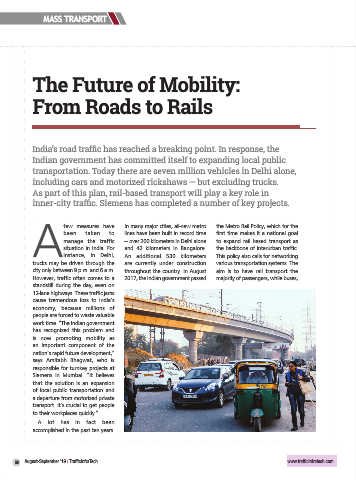
                  India’s road traffic has reached a breaking point. In response, the
                  Indian government has committed itself to expanding local public

                  transportation. Today there are seven million vehicles in Delhi alone,
                  including cars and motorized rickshaws — but excluding trucks.
                  As part of this plan, rail-based transport will play a key role in
                  inner-city traffic. Siemens has completed a number of key projects.


                  A                 taken   to   In many major cities, all-new metro   the Metro Rail Policy, which for the
                            few measures have
                            been
                                                 lines have been built in record time
                                                                                first time makes it a national goal
                            manage the traffic
                                                 — over 200 kilometers in Delhi alone
                                                                                to expand rail based transport as
                            situation in India. For
                                                 and 42 kilometers in Bangalore.
                                                                                the backbone of interurban traffic.
                            instance, in Delhi,
                  trucks may be driven through the   An additional 530 kilometers   This policy also calls for networking
                                                 are currently under construction
                                                                                various transportation systems. The
                  city only between 9 p.m. and 6 a.m.   throughout the country. In August   aim is to have rail transport the
                  However, traffic often comes to a   2017, the Indian government passed   majority of passengers, while buses,
                  standstill during the day, even on
                  12-lane highways. These traffic jams
                  cause  tremendous  loss  to  India’s
                  economy, because millions of
                  people are forced to waste valuable
                  work time. “The Indian government
                  has recognized this problem and
                  is now promoting mobility as
                  an important component of the
                  nation’s rapid future development,”
                  says Amitabh Bhagwat, who is
                  responsible for turnkey projects at
                  Siemens in Mumbai. “It believes
                  that the solution is an expansion
                  of local public transportation and
                  a departure from motorized private
                  transport. It’s crucial to get people
                  to their workplaces quickly.”
                   A lot has in fact been
                  accomplished in the past ten years.


            66  August-September ’19 / TrafficInfraTech                                                 www.trafficinfratech-com-500653.hostingersite.com

