


Page 64 - Trafficinfratech Magazine Aug - Sept
P. 64
TRAFFIC MANAGEMENT


                          in 2030 and 53.6% in 2050 for the   Transport Sector       was suggested  that the metro
                          BaU scenario. The modal share of   Emissions               corridor will be a better option.
                          cars also increases steadily from                          The technical analysis was carried
                          3.7% in 2008 to 4% and 4.6% in   It is seen that there is a lot of   out with the assumption that the
                          2030 and 2050 respectively.   reduction in total emissions and   elevated corridor will be opened
                                                        per capita emissions in sustainable
                            VKT increased  by  55%  and   transport scenarios compared   for traffic in 2020. The simulation
                          132% for 2030 and 2050,       with the BaU scenario.       was  implemented  for  2017,
                          respectively concerning 2008 in                            2020 and 2030 considering the
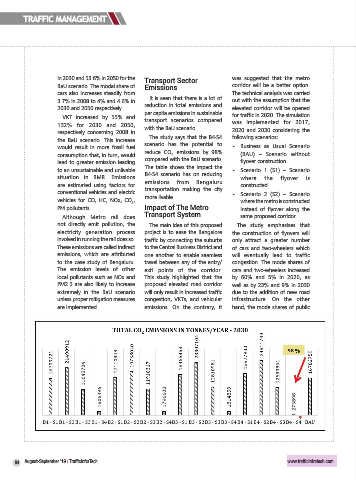
                          the BaU scenario. This increase   The study says that the B4-S4   following scenarios:
                          would result in more fossil fuel   scenario has the potential to   •  Business  as  Usual  Scenario
                          consumption that, in turn, would   reduce CO  emissions by 98%   (BAU) – Scenario without
                                                                 2
                          lead to greater emission leading   compared with the BaU scenario.   flyover construction.
                                                        The table shows the impact the
                          to an unsustainable and unlivable                          •  Scenario 1 (S1) – Scenario
                          situation in BMR. Emissions   B4-S4 scenario has on reducing   where  the   flyover  is
                                                        emissions from Bengaluru
                          are estimated using factors for   transportation making the city   constructed.
                          conventional vehicles and electric   more livable.         •  Scenario 2 (S2) – Scenario
                          vehicles for CO, HC, NOx, CO ,
                                                   2                                    where the metro is constructed
                          PM pollutants.                Impact of The Metro             instead of flyover along the
                            Although Metro rail does    Transport System                same proposed corridor.
                          not directly emit pollution, the   The main idea of this proposed   The study emphasises that
                          electricity generation process   project is to ease the Bangalore   the construction of flyovers will
                          involved in running the rail does so.   traffic by connecting the suburbs   only attract a greater number
                          These emissions are called indirect   to the Central Business District and   of cars and two-wheelers which
                          emissions, which are attributed   one another to enable seamless   will eventually lead to traffic
                          to the case study of Bengaluru.   travel between any of the entry/  congestion. The mode shares of
                          The emission levels of other   exit points of the corridor.   cars and two-wheelers increased
                          local pollutants such as NOx and   This study highlighted that the   by  60%  and  5%  in  2020,  as
                          PM2.5 are also likely to increase   proposed elevated road corridor   well as by 23% and 9% in 2030
                          extremely in the BaU scenario   will only result in increased traffic   due to the addition of new road
                          unless proper mitigation measures    congestion, VKTs, and vehicular   infrastructure. On the other
                          are implemented.              emissions. On the contrary, it   hand, the mode shares of public


            64  August-September ’19 / TrafficInfraTech                                                 www.trafficinfratech-com-500653.hostingersite.com

