


Page 27 - TT mag Sept 2025 Digital Edition
P. 27
ITS


                  However, there are several     •  Better data is needed to      and the supporting smartphone
                challenges and limitations          understand AV acceptance and   application. Specifically, it
                associated with these technologies.   expected AV usage by persons   addresses the design of the
                Many technologies are still in early   with disabilities and other   vehicle itself (i.e., access, exit, and
                development stages, and retrofitting   disadvantaged travelers.   internal and external interactions),
                existing vehicles for accessibility                               the smartphone application
                often faces design, regulatory     From the European perspective,   supporting its use (i.e., including
                and financial challenges. Further,   recent research conducted    technical and informational
                onboard personnel are currently   by the European Commission      features), training programs to
                essential for providing accessible   investigated the accessible design   facilitate service adoption, and
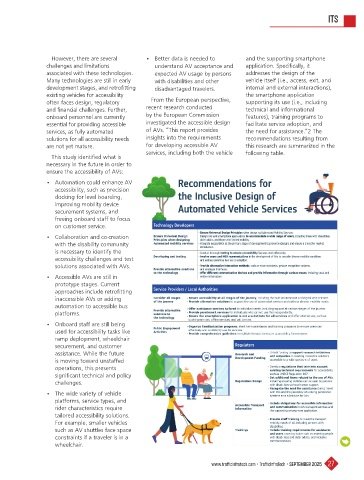
                services, as fully automated     of AVs. “This report provides    the need for assistance.”2 The
                solutions for all accessibility needs   insights into the requirements   recommendations resulting from
                are not yet mature.              for developing accessible AV     this research are summarized in the
                                                 services, including both the vehicle   following table.
                  This study identified what is
                necessary in the future in order to
                ensure the accessibility of AVs:
                •  Automation could enhance AV
                   accessibility, such as precision
                   docking for level boarding,
                   improving mobility device
                   securement systems, and
                   freeing onboard staff to focus
                   on customer service.
                •  Collaboration and co-creation
                   with the disability community
                   is necessary to identify the
                   accessibility challenges and test
                   solutions associated with AVs.
                •  Accessible AVs are still in
                   prototype stages. Current
                   approaches include retrofitting
                   inaccessible AVs or adding
                   automation to accessible bus
                   platforms.
                •  Onboard staff are still being
                   used for accessibility tasks like
                   ramp deployment, wheelchair
                   securement, and customer
                   assistance. While the future
                   is moving toward unstaffed
                   operations, this presents
                   significant technical and policy
                   challenges.
                •  The wide variety of vehicle
                   platforms, service types, and
                   rider characteristics require
                   tailored accessibility solutions.
                   For example, smaller vehicles
                   such as AV shuttles face space
                   constraints if a traveler is in a
                   wheelchair.

                                                                        www.trafficinfratech.com • TrafficInfraTech • SEPTEMBER 2025 27

