


Page 24 - TT mag Sept 2025 Digital Edition
P. 24
ITS


          Rethinking Congestion Management

          The Evolving Role of ATCS in Smart Cities


          More than 50 Smart Cities across India have implemented Adaptive Traffic Control Systems
          (ATCS). Despite this investment, road networks remain highly congested during peak hours, raising
          critical questions for urban planners and traffic engineers. Are these ATCS installations effective?
          Would congestion be worse without them? What can be realistically expected from an ATCS, and
          ultimately, how can we leverage technology to reduce urban congestion? Rajesh Krishnan, CEO, ITS
          Planners and Engineers Private Limited, explores these questions and examines the evolving role of
          ATCS beyond simple signal optimisation.


                t a fundamental level,      Traffic is a stochastic process,   calibration parameters to make
                ATCS is designed to        with vehicles arriving at junctions   real-time adjustments to signal
                reduce congestion. Most    at irregular intervals. Consequently,   timings. These parameters must
                systems installed in India   VA-like functionality that adapts to   be calibrated correctly during
          Autilise tactical green-time     these random arrival patterns can   commissioning and recalibrated
          adjustment logic, terminating a   be reasonably expected to improve   periodically to maintain optimal
          signal stage when it is not being   traffic flow. Furthermore, a modern   performance. Without a structured
          used efficiently. This is often   ATCS harmonises flows across    programme for configuration
          achieved through Vehicle Actuated   multiple junctions by optimising   review and recalibration, an
          (VA) like logic, where green signals   cycle times and offsets holistically   ATCS solution cannot deliver its
          are terminated or extended based   over a wider area, creating a   full potential. Cities must employ
                                                                            qualified technical personnel to
          on vehicle presence or gaps,     smoother traffic experience.     perform these tasks and hold them
          thereby minimising wasted green   If ATCS is effective, why do major   accountable for key congestion-
          time. This efficient management of   intersections remain congested   related metrics. Secondly, if
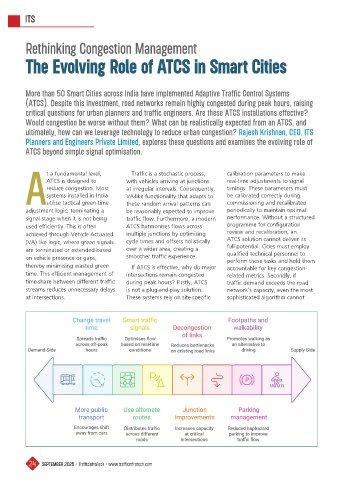
          time-share between different traffic   during peak hours? Firstly, ATCS   traffic demand exceeds the road
          streams reduces unnecessary delays   is not a plug-and-play solution.   network’s capacity, even the most
          at intersections.                These systems rely on site-specific   sophisticated algorithm cannot


           24  SEPTEMBER 2025 • TrafficInfraTech • www.trafficinfratech.com

