


Page 26 - TT mag Sept 2025 Digital Edition
P. 26
ITS


          Ensuring Inclusivity, Accessibility and Equity in

          Automated Mobility Deployment


          Since the development of automated vehicles (AVs), many experts
          in the transportation industry have stated that one of the biggest
          benefits will be improving mobility for disadvantaged travelers
          (e.g., elderly, persons with disabilities, low-income individuals).
          However, many of those statements did not identify what is
          necessary to make AVs improve mobility – is it just that these
          vehicles will be self-driving or are there other vehicle features
          that will facilitate mobility? Upon further investigation, having
          AVs available to disadvantaged travelers will not automatically
          make any improvements – there is a need to ensure that travelers
          accept and trust this type of technology before examining other
          needs of disadvantaged travelers. Carol Schweiger, President,
          Schweiger Consulting LLC, writes for Trafficinfratech


                tepping back for a moment,    result in societal or ethical   given these perspectives? In August
                when examining intelligent    issues. Data may not be       2022, the US Federal Transit
                transportation systems (ITS),   impartial since the data may be   Administration conducted a study
                such as AVs, with an equity   used in a way that can create   of the practices and ongoing
          Slens, there are three major                                      research on accessible public
          perspectives to consider:           biases.                       transportation automation. The key
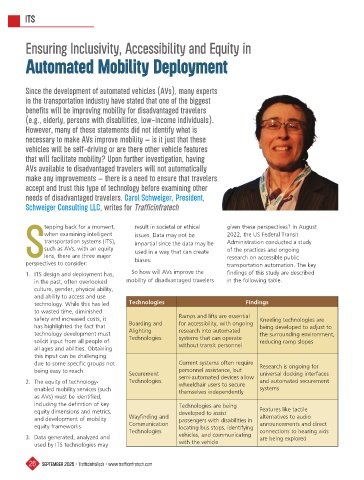
          1.  ITS design and deployment has,   So how will AVs improve the   findings of this study are described
            in the past, often overlooked   mobility of disadvantaged travelers   in the following table.
            culture, gender, physical ability,
            and ability to access and use
            technology. While this has led   Technologies                         Findings
            to wasted time, diminished
            safety and increased costs, it                  Ramps and lifts are essential   Kneeling technologies are
            has highlighted the fact that   Boarding and    for accessibility, with ongoing   being developed to adjust to
            technology development must     Alighting       research into automated    the surrounding environment,
            solicit input from all people of   Technologies  systems that can operate   reducing ramp slopes
            all ages and abilities. Obtaining               without transit personnel
            this input can be challenging
            due to some specific groups not                 Current systems often require   Research is ongoing for
            being easy to reach.                            personnel assistance, but
                                            Securement      semi-automated devices allow   universal docking interfaces
          2.  The equity of technology-     Technologies    wheelchair users to secure   and automated securement
            enabled mobility services (such                 themselves independently   systems
            as AVs) must be identified,
            including the definition of key                 Technologies are being
            equity dimensions and metrics,                  developed to assist        Features like tactile
            and development of mobility     Wayfinding and   passengers with disabilities in   alternatives to audio
            equity frameworks.              Communication   locating bus stops, identifying   announcements and direct
                                            Technologies                               connections to hearing aids
          3.  Data generated, analyzed and                  vehicles, and communicating   are being explored
            used by ITS technologies may                    with the vehicle

           26  SEPTEMBER 2025 • TrafficInfraTech • www.trafficinfratech.com

