


Page 36 - TT June issue pdf for digital
P. 36
SUSTAINABILITY


                                                                            well-being front and centre.
                                                                            Over the years, the Netherlands
                                                                            developed into what it is today
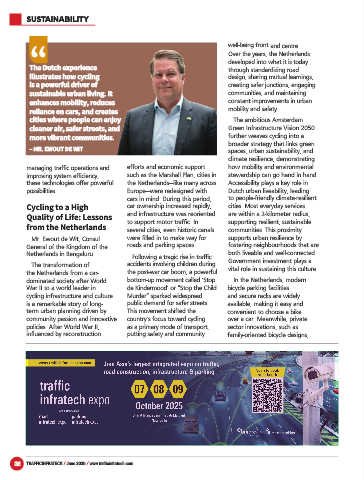
           The Dutch experience                                             through standardizing road
           illustrates how cycling                                          design, sharing mutual learnings,
           is a powerful driver of                                          creating safer junctions, engaging
           sustainable urban living. It                                     communities, and maintaining
           enhances mobility, reduces                                       constant improvements in urban
           reliance on cars, and creates                                    mobility and safety.
           cities where people can enjoy                                      The ambitious Amsterdam
           cleaner air, safer streets, and                                  Green Infrastructure Vision 2050
           more vibrant communities.                                        further weaves cycling into a
                                                                            broader strategy that links green
           – MR. EWOUT DE WIT                                               spaces, urban sustainability, and
                                                                            climate resilience, demonstrating
          managing traffic operations and   efforts and economic support    how mobility and environmental
          improving system efficiency,     such as the Marshall Plan, cities in   stewardship can go hand in hand.
          these technologies offer powerful   the Netherlands—like many across   Accessibility plays a key role in
          possibilities.                   Europe—were redesigned with      Dutch urban liveability, leading
                                           cars in mind. During this period,   to people-friendly climate-resilient
          Cycling to a High                car ownership increased rapidly,   cities. Most everyday services
          Quality of Life: Lessons         and infrastructure was reoriented   are within a 2-kilometer radius,
                                                                            supporting resilient, sustainable
          from the Netherlands             to support motor traffic. In     communities. This proximity
                                           several cities, even historic canals
           Mr. Ewout de Wit, Consul        were filled in to make way for   supports urban resilience by
          General of the Kingdom of the    roads and parking spaces.        fostering neighbourhoods that are
          Netherlands in Bengaluru          Following a tragic rise in traffic   both liveable and well-connected.
           The transformation of           accidents involving children during   Government investment plays a
                                                                            vital role in sustaining this culture.
          the Netherlands from a car-      the post-war car boom, a powerful
          dominated society after World    bottom-up movement called ‘Stop    In the Netherlands, modern
          War II to a world leader in      de Kindermood’ or “Stop the Child   bicycle parking facilities
          cycling infrastructure and culture   Murder” sparked widespread   and secure racks are widely
          is a remarkable story of long-   public demand for safer streets.   available, making it easy and
          term urban planning driven by    This movement shifted the        convenient to choose a bike
          community passion and innovative   country’s focus toward cycling   over a car. Meanwhile, private
          policies. After World War II,    as a primary mode of transport,   sector innovations, such as
          influenced by reconstruction     putting safety and community     family-oriented bicycle designs,


                                                                                                              TT


     36   TRAFFICINFRATECH / June 2025 / www.trafficinfratech.com

