


Page 24 - TT Aug-Sept pdf for digital
P. 24
FOCUS


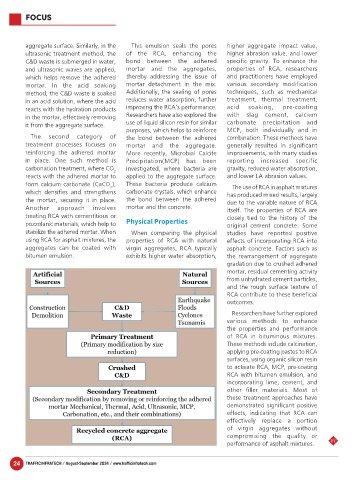
         aggregate surface. Similarly, in the   This emulsion seals the pores   higher aggregate impact value,
         ultrasonic treatment method, the   of the RCA, enhancing the       higher abrasion value, and lower
         C&D waste is submerged in water,   bond between the adhered        specific gravity. To enhance the
         and ultrasonic waves are applied,   mortar and the aggregates,     properties of RCA, researchers
         which helps remove the adhered    thereby addressing the issue of   and practitioners have employed
         mortar. In the acid soaking       mortar detachment in the mix.    various secondary modification
         method, the C&D waste is soaked   Additionally, the sealing of pores   techniques,  such  as  mechanical
         in an acid solution, where the acid   reduces water absorption, further   treatment, thermal treatment,
         reacts with the hydration products   improving the RCA’s performance.   acid  soaking,  pre-coating
         in the mortar, effectively removing   Researchers have also explored the   with slag cement, calcium
         it from the aggregate surface.    use of liquid silicon resin for similar   carbonate precipitation and
                                           purposes, which helps to reinforce   MCP, both individually and in
           The second category of          the bond between the adhered     combination. These methods have
         treatment processes focuses on    mortar and the aggregate.        generally resulted in significant
         reinforcing the adhered mortar    More recently, Microbial Calcite   improvements, with many studies
         in  place.  One such method  is   Precipitation(MCP) has been      reporting increased specific
         carbonation treatment, where CO    investigated, where bacteria are   gravity, reduced water absorption,
                                       2
         reacts with the adhered mortar to   applied to the aggregate surface.   and lower LA abrasion values.
         form calcium carbonate (CaCO ),   These bacteria produce calcium     The use of RCA in asphalt mixtures
                                     2
         which densifies and strengthens   carbonate crystals, which enhance   has produced mixed results, largely
         the mortar, securing it in place.   the bond between the adhered   due to the variable nature of RCA
         Another approach involves         mortar and the concrete.         itself. The  properties  of RCA are
         treating RCA with cementitious or                                  closely tied to the history of the
         pozzolanic materials, which help to   Physical Properties          original cement concrete. Some
         stabilize the adhered mortar. When   When comparing the physical   studies have reported positive
         using RCA for asphalt mixtures, the   properties  of  RCA with natural   effects of incorporating RCA into
         aggregates can be coated with     virgin aggregates, RCA typically   asphalt concrete. Factors such as
         bitumen emulsion.                 exhibits higher water absorption,   the rearrangement of aggregate
                                                                            gradation due to crushed adhered
                                                                            mortar, residual cementing activity
                                                                            from unhydrated cement particles,
                                                                            and the rough surface texture of
                                                                            RCA contribute to these beneficial
                                                                            outcomes.
                                                                              Researchers have further explored
                                                                            various methods to enhance
                                                                            the properties and performance
                                                                            of  RCA  in  bituminous  mixtures.
                                                                            These methods include calcination,
                                                                            applying pre-coating pastes to RCA
                                                                            surfaces, using organic silicon resin
                                                                            to activate RCA, MCP, pre-coating
                                                                            RCA with bitumen emulsion, and
                                                                            incorporating lime, cement, and
                                                                            other filler materials. Most of
                                                                            these treatment approaches have
                                                                            demonstrated significant positive
                                                                            effects, indicating that RCA can
                                                                            effectively  replace  a  portion
                                                                            of  virgin aggregates without
                                                                            compromising the quality or
                                                                            performance of asphalt mixtures.     TT


     24   TRAFFICINFRATECH / August-September 2024 / www.trafficinfratech.com

