


Page 33 - TT July Issue for Digital Edition
P. 33
ROAD SAFETY


                   Tunnel Lighting –
                   For comfort, safety


                   and visual performance


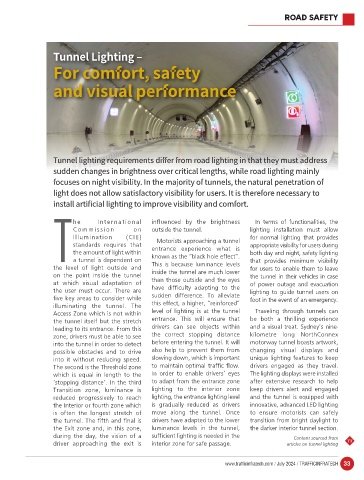
                   Tunnel lighting requirements differ from road lighting in that they must address
                   sudden changes in brightness over critical lengths, while road lighting mainly
                   focuses on night visibility. In the majority of tunnels, the natural penetration of

                   light does not allow satisfactory visibility for users. It is therefore necessary to
                   install artificial lighting to improve visibility and comfort.


                         he      International     influenced  by  the  brightness   In terms of functionalities, the
                         Commission          on    outside the tunnel.              lighting installation must allow
                         Illumination      (CIE)     Motorists approaching a tunnel   for normal lighting that provides
                         standards requires  that                                   appropriate visibility for users during
                         the amount of light within   entrance experience  what is   both day and night, safety lighting
                   Ta tunnel is dependent on       known as the “black hole effect”.   that provides minimum visibility
                   the  level  of  light  outside  and   This is because luminance levels   for users to enable them to leave
                   on  the  point inside  the  tunnel   inside the tunnel are much lower   the tunnel in their vehicles in case
                   at  which  visual  adaptation  of   than those outside and the eyes   of power outage and evacuation
                   the user must occur. There are   have difficulty adapting to the   lighting to guide tunnel users on
                   five key areas to consider while   sudden difference. To alleviate   foot in the event of an emergency.
                   illuminating the tunnel. The    this effect, a higher, “reinforced”
                   Access Zone which is not within   level of lighting is at the tunnel   Traveling through tunnels can
                   the tunnel itself but the stretch   entrance. This will ensure that   be  both  a  thrilling  experience
                   leading to its entrance. From this   drivers can see objects within   and a visual treat. Sydney’s nine-
                   zone, drivers must be able to see   the correct stopping distance   kilometre long NorthConnex
                   into the tunnel in order to detect   before entering the tunnel. It will   motorway tunnel boasts artwork,
                   possible obstacles and to drive   also help to prevent them from   changing visual displays and
                   into  it  without reducing  speed.   slowing down, which is important   unique lighting features to keep
                   The second is the Threshold zone   to maintain optimal traffic flow.   drivers  engaged as they  travel.
                   which is equal in length to the   In order to enable drivers’ eyes   The lighting displays were installed
                   ‘stopping distance’. In the third   to adapt from the entrance zone   after extensive research to help
                   Transition zone, luminance is   lighting to the interior zone    keep drivers alert and engaged
                   reduced progressively to reach   lighting, the entrance lighting level   and the tunnel is equipped with
                   the Interior or fourth zone which   is gradually reduced as drivers   innovative, advanced LED lighting
                   is often the longest stretch of   move along the tunnel. Once    to ensure motorists can safely
                   the tunnel. The fifth and final is   drivers have adapted to the lower   transition from bright daylight to
                   the Exit zone and, in this zone,   luminance  levels in  the  tunnel,   the darker interior tunnel section.
                   during the day, the vision of a   sufficient lighting is needed in the         Content sourced from
                   driver approaching the exit is   interior zone for safe passage.             articles on tunnel lighting  TT


                                                                           www.trafficinfratech.com / July 2024 / TRAFFICINFRATECH  33

