


Page 39 - TrafficInfraTech Magazine - July Digital Edition
P. 39
PUBLIC TRANSPORT


                                                                                   •  Tailor Services for Different
                                                                                      Demographics: Designing last-
                                                                                      mile services based on station
                                                                                      demographics, to cater to the
                                                                                      preferences of different commuter
                                                                                      segments, is crucial. For instance,
                                                                                      cities can consider introducing
                                                                                      on-demand, app-based mobility
                                                                                      services  in  higher-income  areas
                                                                                      where demand for faster and
                                                                                      more comfortable modes may be
                                                                                      a preference.
                                                                                   •  Ensure  Affordability  and
                                                                                      Accessibility: Prioritizing the
                                                                                      development of low-cost
                                                                                      shared services and access
                                                                                      infrastructure, catering to a
                                                                                      broader range of commuters,
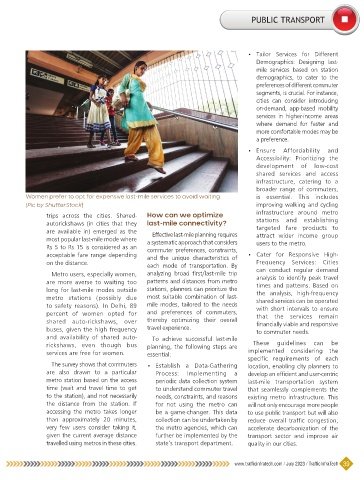
          Women prefer to opt for expensive last-mile services to avoid waiting.      is essential. This includes
          (Pic by ShutterStock)                                                       improving walking and cycling
                trips across the cities. Shared-  How can we optimize                 infrastructure around metro
                autorickshaws (in cities that they   last-mile connectivity?          stations and establishing
                are available in) emerged as the   Effective last-mile planning requires   targeted  fare  products to
                most popular last-mile mode where   a systematic approach that considers   attract wider income group
                Rs 5 to Rs 15 is considered as an   commuter preferences, constraints,   users to the metro.
                acceptable fare range depending   and the unique characteristics of   •  Cater for Responsive High-
                on the distance.                  each mode of transportation. By     Frequency Services: Cities
                  Metro users, especially women,   analyzing broad  first/last-mile  trip   can conduct regular demand
                                                                                      analysis to identify peak travel
                are more averse to waiting too    patterns and distances from metro   times and patterns. Based on
                long for last-mile modes outside   stations, planners can prioritize the   the analysis, high-frequency
                metro stations (possibly due      most suitable combination of last-  shared services can be operated
                to safety reasons). In Delhi, 89   mile modes, tailored to the needs   with short intervals to ensure
                percent of women opted  for       and preferences of commuters,       that the services remain
                shared  auto-rickshaws,  over     thereby  optimizing  their  overall   financially viable and responsive
                buses, given the high frequency   travel experience.                  to commuter needs.
                and  availability  of  shared  auto-  To achieve successful last-mile
                rickshaws, even though bus        planning, the following steps are   These guidelines can be
                services are free for women.      essential:                       implemented considering the
                                                                                   specific requirements of each
                  The survey shows that commuters   •  Establish  a  Data-Gathering   location, enabling city planners to
                are also drawn to a particular      Process: Implementing a        develop an efficient and user-centric
                metro station based on the access   periodic data collection system   last-mile transportation system
                time (wait and travel time to get   to understand commuter travel   that seamlessly complements the
                to the station), and not necessarily   needs, constraints, and reasons   existing metro infrastructure. This
                the distance from the station. If   for not using the metro can    will not only encourage more people
                accessing the metro takes longer    be a game-changer. This data   to use public transport but will also
                than approximately  20 minutes,     collection can be undertaken by   reduce overall traffic congestion,
                very few users consider taking it,   the metro agencies, which can   accelerate decarbonization of the
                given the current average distance   further be implemented by the   transport  sector  and  improve  air
                travelled using metros in these cities.   state’s transport department.  quality in our cities.


                                                                               www.trafficinfratech-com-500653.hostingersite.com / July 2023 / TrafficInfraTech  39

