


Page 61 - Traffic Infra Tech Magazine
P. 61
URBAN DESIGN


                                                     The way-finding within Taj Ganj and at all
                                                     gates has been done to make navigation a

                                                     meaningful and enjoyable experience,
                                                     the way-finding signage becomes a precursor to
                                                     creating varied perspectives of the city.


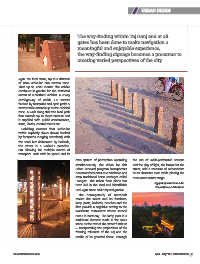
                  Agra, the local stone, up to a distance
                  of zero–vehicular 500 metres zone.
                  Then up to 1200 metres, the cobble
                  continues in granite for the restricted
                  access of motorized vehicles. A 2-way
                  carriageway of width 7.5 metres
                  flanked by footpaths and cycle paths 5
                  metres wide extends up to the cobbled
                  zone. A walk along this tree-lined path
                  that extends up to shops enroute and
                  is supplied with public conveniences,
                  seats, kiosks, control rooms etc.
                   Cobbling ensures that vehicular
                  traffic explicitly slows down; backed
                  by footpaths merging seamlessly with
                  the road but delineated by bollards,
                  the street is a walker’s paradise.
                  But allowing for multiple modes of
                  transport, each with its speed and its

                                                    own system of perception operating   the use of Jaalis-perforated screens
                                                    simultaneously,  the  vision  for  this   and the play of light, the lamps dot the
                                                    urban renewal program incorporates   street, add a measure of romanticism
                                                    non-motorised ones as e-rickshaws and   to its character even while placing the
                                                    even traditional horse carriages called   monument centre stage.
                                                    ‘Tongas’. The urban floor plane has            A project by archohm consults.
                                                    been laid in the local and identifiable         Pictures by Andre J Fanthome
                                                    Red Agra stone and ruby red granite.
                                                      The  homogeneity  of materials
                                                    makes  the  street  and  its  furniture-
                                                    lamp posts, bollards, benches and the
                                                    likes provide a cognitive setting to the
                                                    wondrous monument whose second
                                                    name is harmony. The lamp post is a
                                                    sculptural element made in the same
                                                    stone as the rest of the street furniture
                                                    — incorporating the proportions of the
                                                    framing minarets of the Taj and the
                                                    profile of its graceful dome. Through


              www.trafficinfratech-com-500653.hostingersite.com                                                             April - May ’18 / TrafficInfraTech  61

