


Page 27 - TrafficInfraTech Magazine | Linking People Places & Progress
P. 27
FOCUSARKING MANAGEMENT
                                                                                           P


                                                                      What are the cost
                                                                      effective technology
                                                                      that can be used to
                                                                      enforce the parking
                                                                      policy not only at
                                                                      dedicated parking
                                                                      bays but also at
                                                                      stretches of roads
                                                                      where one is not
                                                                      supposed to park? So, how do we enforce
                  going down because rules are easier. One need not include   because the moment you start charging for
                  20sqmtrs per apartment for a car. It is easier in Delhi because
                  public transport is more organised. Parking should be used to   parking people will go off and start parking
                  create revenue and revenue should be used to improve the   somewhere else.?
                  situation of public transport.
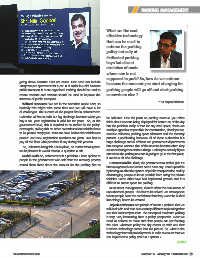
                                                                                                     – Dr Rajesh Krishnan
                    Wilfred Menezes: We are in the transition mode now, so
                  basically this might take some time and we will have a lot
                  of challenges. The success of the project lies in enforcement.
                  Collection of fine in India is a big challenge because when you   be collected. One the point on parking revenue, you often
                  buy a car, your registration is valid for ten years.  So, at the   think about revenue being deployed for better use of the city
                  government level, this is required to be ratified in the policy.   but the problem really is that for any road space, these are
                  Now again, taking this  to other countries where vehicles have   multiple agencies responsible for construction, development,
                  to be passed every year, tests are done before the vehicles are   revenue collection, parking space allotment and the recovery
                  passed  and new registration numbers are given. One has to   process. Coordinating between all of these authorities is a
                  pay all the fines with penalties if any during this process.  huge challenge and all of these are government departments
                     So, unless we bring this rule in place, no matter what system   but everyone wants a slice of the revenue because often they
                  we implement it would remain  a question mark.      are under-budget on various things. Unless you actually figure
                                                                      out where the parking revenue is going to go in the first place,
                    Sachin Naik: So, enforcement is a problem. I have spoken to   it can be a bit of a challenge.
                  people in the government who said that the recovery process
                  costed them three times the amount for the parking fine to   Harmeet Malik: I think, the government must first give it a
                                                                      human approach and create some harmony. That is possible
                                                                      by having an effective system of public transportation and by
                                                                      discouraging people as far as possible from using the private
                                                                      vehicles. Some cities have had haphazard growth and it is
                                                                      difficult to create space for parking.
                                                                        In on-street management, there is often the dominance of
                                                                      unauthorised groups. This has to be solved. An atmosphere
                                                                      where people have the confidence that they won’t be bullied
                                                                      into things, has to be created.
                                                                         Rajesh Krishnan: Corruption is of course a problem that we
                                                                      will deal with and that is an entirely different topic altogether
                                                                      and that is not easy to solve. The concept of maximum parking
                                                                      is very, very interesting from a policy perspective. Now we
                                                                      need to enforce to make sure that people are not flouting
                                                                      the rules, whatever policy the city comes up with and that
                                                                      is where technology comes into the picture. So, what is the
                                                                      technology that will probably work in India to ensure that we
                                                                      can implement a policy and run a system.?


              www.trafficinfratech-com-500653.hostingersite.com                                                     December ’17 - January ’18  / TrafficInfraTech  27

