


Page 72 - TT mag Oct-Nov -Digital
P. 72
SMART MOBILITY 2018


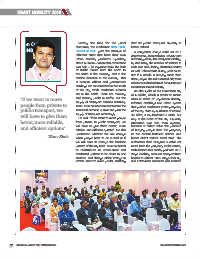
                                                     Setting the tone for the panel    that its public transport capacity is
                                                   discussion, the moderator Nirav Shah,   better utilised.
                                                   Partner at PwC, gave the example of   A congestion charge could act as a
                                                   different cities that have their own   deterrent to private vehicles. Tel Aviv uses
                                                   urban mobility problems. Speaking   technology to implement dynamic tolling,
                                                   about Mumbai – where this conference   by calculating the number of vehicles in
                                                   was held – he explained how the bulk   each lane and plotting alternative routes
                                                   of traffic moves from the north to   as well. Tolls increase during peak hours.
                                                   the south in the morning, and in the   But if a vehicle is ferrying more than
                                                   reverse direction in the evening. This   three people, the toll is waived off; these
                                                   is because offices and government   influences individual travel behaviour and
                                                   buildings are concentrated in the south   incentivises shared mobility.
                                                   of the city, while residential suburbs   He also spoke of the Colombian city
                                                   are in the north. There are morning   of Medellín, which is similar to Indian
              “If we want to move                  and evening peaks in traffic, but the   cities in terms of population density,
                                                   supply  of  transport  remains  relatively
              people from private to               static. Mumbai needs to account for the   informal dwellings and urban sprawl
                                                                                       that pushes residences to the periphery
              public transport, we                 increased demand uptake and plan the   of the city. With a population of around
              will have to give them               supply of transport accordingly.    30 lakhs, it implemented a BRTS, but
                                                     He said, “If we want to move people
                                                                                       only in the heart of the city. Capacity
              better, more reliable,               from private to public transport, we   utilisation was less than optimal,
              and efficient options”.              will have to give them better, more   because it didn’t solve the problem
                                                   reliable, and efficient options”. He also   of ferrying people from the periphery
                                                   questioned whether we can change    to the central business district, and
                                 Nirav Shah        when people have to be moved or if   hence  didn’t  reduce  travel  time.  The
                                                   we will have to change the land-use   authorities then designed a cable car
                                                   pattern of the city itself. Mumbai needs   route from the periphery to the centre,
                                                   to redistribute its commercial and   with stations that overlapped with BRTS
                                                   residential pockets to be closer to one   stops, enabling seamless transport from
                                                   another, and change office timings in   homes to offices. BRTS usage shot up,
                                                   certain areas to avoid peaks, ensuring   and a two-hour commute was reduced


        72  October-November ’18 / TrafficInfraTech                                                        www.trafficinfratech-com-500653.hostingersite.com

