


Page 39 - TT Magazine Feb-Mar 2019
P. 39
INFRASTRUCTURE


                                                                the construction of a simple cable-stayed bridge was planned. It
                                                                was decided to implement the project through a single package,
                                                                involving the construction of both the main bridge as well as the
                                                                eastern and western approaches. After the receipt & tender, it
                                                                required revised cost sanction and finally, in 2009, the decision to
                                                                split the project into two packages was taken. The first package
                                                                entailed the construction of the western and eastern approaches
                                                                while the second package involved the construction of the cable-
                                                                stayed bridge. In February 2010, the second package covering
                                                                main bridge was awarded to a joint venture (JV) of Gammon
                                                                India, Brazil’s Construtora Cidade and Italy’s Tensacciai. Following
                                                                the project award, construction commenced in March 2010.
                                                                Challenges on the way
                                                                  The journey of the project, right from conceptualisation to
                                                                          construction, was with several challenges. One of
                                                                          the major issues faced in the initial stage was that
                                                                          of obtaining the forest clearance. While DTTDC
                                                                          had applied for the clearance in 2007, it was only
                                                                          granted after a five-year period in 2012. “Geological
                                                                          surprises and the consequent need to redesign and
                                                                          execute foundation P-23 of the bridge proved to be
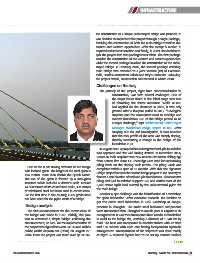
                                                                          a major challenge,” says Shishir Bansal, Chief Project
                                                                          Manager, Wazirabad Bridge Project, DTTDC. After
                                                                          carrying out the soil investigation, it was revealed
                                                                          that the rock profile of the area was steeply sloping,
                                                                          thereby warranting a change in the design of the
                                                                          foundation P-23.
                                                                  In August 2012, a proposal for an integrated well-pile foundation
                                                                was approved and the well sinking started. In December 2014,
                                                                Gammon India acquired two new reverse circulation drilling rigs
                                                                from Korean firm Buma CE. These rigs were used for undertaking
                                                                piling work on the sloping rock terrain. The piling work was
                       One of the most striking features of the bridge   completed within a span of 16 months. With this, the Signature
                      is its inclined pylon. The height of the steel pylon is   Bridge project became the second bridge project in the country to
                      154 metres, more than double the Qutub Minar.   feature a combination of well and pile foundations. This extensive
                      The top of the pylon is formed by a steel-glass   piling and well foundation support P-23 and carries most of the
                      structure which includes a viewer’s deck. Around   6,600 tonne uplift load exerted by the cable-stressed pylon for
                      14,500 tonnes of structured steel and 6,300 tonnes   the main bridge.
                      of reinforced steel has been used in construction.
                      For the first time in the country, E355 grade steel   Another major challenge was the identification of a workshop
                      has been used for the pylon work of a bridge.  for pylon fabrication. After extensive research, the decision to
                                                                get the entire steel fabrication in ZTSS workshop at Jiangsu
                      Design analysis                           province in Shanghai. The entire steel fabricated components
                       The first announcement for the construction of   were transported from Shanghai to Kandla port in Gujarat in six
                      the bridge was made in 1997. Initially, the plan   consignments. It was then transported from Kandla to Wazirabad
                      was to construct a simple bridge. Following the   in Delhi to the bridge site, covering a distance of 1,640 km by
                      announcement, an MoU for the implementation of   road. The base was transported in modular trailers with 12 axles
                      the project was signed between DTTDC and Delhi’s   and 168 wheels with each axle having independent hydraulic
                      public works department (PWD) on August 27,   arrangement. Transportation of the shipment was done mainly
                      2004. Once the project was taken over by DTTDC,   at night. A separate bypass had to be set up enroute besides


              www.trafficinfratech-com-500653.hostingersite.com                                                         February - March ’19 / TrafficInfraTech  39

