


Page 62 - TrafficInfraTech Dec-Jan 2019
P. 62
MOBILITY


                                                    Over 2006 to 2014, the Ministry of   The guidance for cycling included not
                                                  Urban  Development  introduced  the   only cycle tracks to provide safer cycling
                                                  Jawaharlal Nehru National Urban Reforms   infrastructure but also acknowledging
                                                  Mission and created urban mobility   that women and girls may not have
                                                  indicators as well as comprehensive   access to bicycles and that they may
                                                  mobility plans for over 63 cities across   be afraid or not know how to cycle. An
                                                  India. The goal of the mobility indicators   example of this is in Santiago where
                                                  was to compare cities, so that they would   a women’s collective called Macleta
                                                  establish a baseline, they would compare   worked with women in order to teach
                                                  and compete in saying in what ways   them  how  to  cycle  and  in  order  to
                                                  they  were  achieving the sustainability   how to repair the bicycles and cycles
                                                  goals. When we began to evaluate   in groups. When these were combined
                                                  these mobility indicators we found that   with cycling infrastructure across the city
                                                  gender was not explicitly and consistently   they found that women’s mode-share of
                                                  integrated in the mobility plans.  cycling increased from 10 percent to 30
                                                    One of the indicators looks at average
                  Organically, Indian cities      waiting time for a bus at a bus stop   percent over a decade.
                                                                                       Public transport needs to look not only
                  are growing linearly; they      in the peak hours. This data is not   at first and last mile connectivity but also
                    are not doing a radial        disaggregated by gender which it doesn’t   travel within the buses and at stations.
                                                  include the city and the peripheral areas
                  development. How do we          and doesn’t include peak and off-peak

                 make some kind of a land-        hours. This is a problem because this
                                                  could hide the higher waiting times for
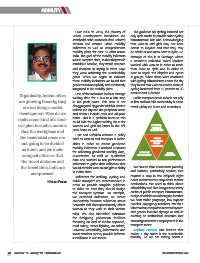
                 use plan in such a manner        women and girls for buses in the off-           PHYSICAL
                                                                                                  DESIGN &
                   that the workplace and         peak hours as well.                            OPERATIONS
                                                    ITDP and SafetiPin released a policy
                   the residential areas are      brief on women and transport in Indian          GENDER
                   not going to be divided        cities in order to create gendered             RESPONSIVE
                                                                                                   URBAN
                                                                                                 TRANSPORT
                    so much and we make           mobility indicators. It outlined a process
                                                  for  collecting gendered  mobility data,
                                                                                                          SOCIAL
                                                                                          ECONOMIC
                    compact cities so that        quantitative as well as qualitative   OPPORTUNITIES    BEHAVIOUR
                   the travel distance and        data and wanted to use performance
                                                  indicators to guide data collection that
                   the travel time, both are      would consider women and girls mobility   We have to think about route planning
                         compressed.              in Indian cities.                  and services, particularly services that
                                                    Indicators for walking, cycling and   request a stop in the off-peak night
                                   Krishna Prasad  public transport are recommended in   hours so that women stop closer to their
                                                  order to provide tangible guidance   destinations. We need to think about
                                                  to cities on how they should design   affordability and fare integration; safety
                                                  the transport systems. For example,   audits of public transport infrastructure,
                                                  we provided indicators on street   design of vehicles considering the fact that
                                                  connectivity because suburban street   we have wider gangways, low support
                                                  networks will disproportionately affect   handles, emergency numbers, real time
                                                  women as they walk to their various   information; complaints redressal system
                                                  trips. We also identified indicators   and gender inclusive signage as well as
                                                  for designing pedestrian facilities   creating an  institutional  structure  that
                                                  focussing on level of service approach,   encourages women’s employment in the
                                                  road safety, street lighting, amenities,   transport sector.
                                                  universal accessibility, information and   Krishna  Prasad:  One  feature  that
                                                  street vendors as they provide informal   makes a city smart is the sustainable
                                                  surveillance in our streets.       mobility. So we are talking about a


            62  December ’18 - January ’19  / TrafficInfraTech                                          www.trafficinfratech-com-500653.hostingersite.com

