


Page 58 - TT Magazine Aug-Sep 2018
P. 58
PARKING


                           that contract parkers entering at   between a vehicle and pedestrians,   are displayed on a LED sign similar
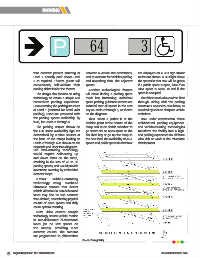
                           Level 1 actually park  above  Level   and to account for vehicles parking   to the one shown. A LED light above
                           3 as required. Theatre guests will   and unparking from the adjacent   the spaces in that row will be green
                           conveniently self-validate their   spaces.                    if a public space is open, blue if an
                           parking ticket inside the theatre.  Another  technological feature   ADA space is open, or red if the
                            The design also focuses on using   will make finding a parking space   space is occupied.
                           technology to create a simple and   much less frustrating. Individual   The fabric mesh allows air to flow
                           convenient parking experience.   space parking guidance sensors are   through, aiding with the parking
                           Upon entering the parking structure   included over all spaces in the east   structure’s openness calculation as
                           at Level 1 (reserved for hotel valet   bay at Levels 2 through 5, as shown   required by code to dissipate vehicle
                           parking), users are presented with   on the diagrams.         emissions.
                           the parking spaces availability, by   Thus, when a parker is at the   Now under construction, these
                           level, for Levels 2 through 6.   decision point at the bottom of the   architectural, parking equipment,
                            The parking counts shown on   ramp and must decide whether to   and vehicle-counting technologies
                           the LED space availability sign are   go search for an open space on the   transform the facility into a high-
                           determined by motion sensors at   flat third bay or go up the ramp to   end parking experience for all those
                           the base of the ramps leading to   the next level, the availability of ADA   who visit or work at the mixed-use
                           Levels 2 through 6 as shown on the   spaces and public spaces in that row   development.
                           Isometric and Floor Plan diagrams.
                           Old  level-counting  technology
                           would require delineating up
                           and down lanes on the ramp,
                           resulting in the loss of 20 to 30
                           parking spaces, and would provide
                           inaccurate counting by embedded
                           detector loops.
                            Newer     vehicle-counting
                           technology using overhead
                           ultrasonic sensors that detect
                           vehicle direction in non-delineated
                           lanes may also be less accurate
                           than desired, necessitating physical
                           counts of open spaces and daily
                           count system resetting.
                            Now, video camera analytic
                           technology senses vehicle motion
                           in non-delineated bi-directional
                           lanes (so  no lost  spaces on
                           the  ramps),  providing  more
                           accurate counts. The cameras
                           are programmed to differentiate
                                                        Source: Parking Today


            58  August-September ’18 / TrafficInfraTech                                                 www.trafficinfratech-com-500653.hostingersite.com

