


Page 37 - TT Magazine Aug-Sep 2018
P. 37
MOBILITY


                                 lush green city surrounded by hills to its west, Pune was for
                                 long ordained as the pensioner’s paradise. That is till the   Rainbow at the end of the
                                 last couple of decades, during which the city underwent a   tunnel
                                 tremendous transformation. Now a bustling metropolitan,
                       Athe city has been caught in the throes of urbanisation and     Back in 2007, Pune city officials realised
                       residents left to deal with the many woes compelled upon them.   that transportation plays a pivotal role
                                                                                      in meeting its sustainability goals. And
                        Realising the city was not far from spiraling out of bound, city officials,   bringing about this systematic change
                       in 2007, proposed a set of ambitious goals for a sustainable future. A   required an improvement of the public
                       decade later, Pune has begun reaping the benefits of taking a sustainable   transport  sector  from  the  ground-up.
                       path—which till a few years back was an afterthought for many Indian   Focus soon shifted to Pune’s robust bus
                       cities. The city’s efforts have been corroborated by its selection to   service, which required a complementary
                       various Central programmes and felicitations, such as being one of  the   network system, such as the bus rapid
                       “Lighthouse Cities” under the nationwide urban renewal program, the   transit (BRT) system, to meet the city’s
                       Smart Cities Mission, etc.                                     growing urban mobility needs.
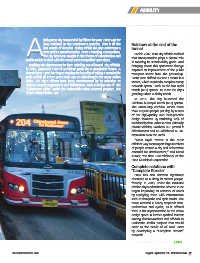
                                                                                       In 2015, the city launched the
                                                                                      Rainbow bus rapid transit (BRT) system.
                                                                                      The  38km-long  corridor  serves  more
                                                                                      than 120,000 people per day, by means
                                                                                      of  its  high-quality and best-practice
                                                                                      design features. By retrieving 12% of
                                                                                      its ridership from other modes, primarily
                                                                                      private vehicles, Rainbow BRT proved it
                                                                                      effectiveness and an additional 43 km
                                                                                      expansion is on the cards.
                                                                                       “Mass rapid transit is the most
                                                                                      efficient way to transport large numbers
                                                                                      of people around a city and is therefore
                                                                                      essential for development,” said Kunal
                                                                                      Kumar, the then Commissioner of the
                                                                                      Pune Municipal Corporation.
                                                                                      Complete solutions with
                                                                                      “Complete Streets”
                                                                                       Pune has also devoted significant
                                                                                      resources to making its streets people-
                                                                                      friendly. In 2009, under the JNNURM
                                                                                      Mission city-modernisation scheme, Pune
                                                                                      began improving its network of roads
                                                                                      by equipping them with infrastructure
                                                                                      such as footpaths and cycle tracks. The
                                                                                      move received a hearty response from
                                                                                      pedestrians and cyclist, as it  offered
                                                                                      them a fair representation in the urban
                                                                                      design space. It further sparked interest
                                                                                      among decision-makers and officials to
                                                                                      undertake similar projects that would
                                                                                      cater to the needs of all road users
                                                                                      by developing a “Complete Streets”
                                                                                      network.


              www.trafficinfratech-com-500653.hostingersite.com                                                        August-September ’18 / TrafficInfraTech  37

